A Colossal Shield Volcano on the Red Planet
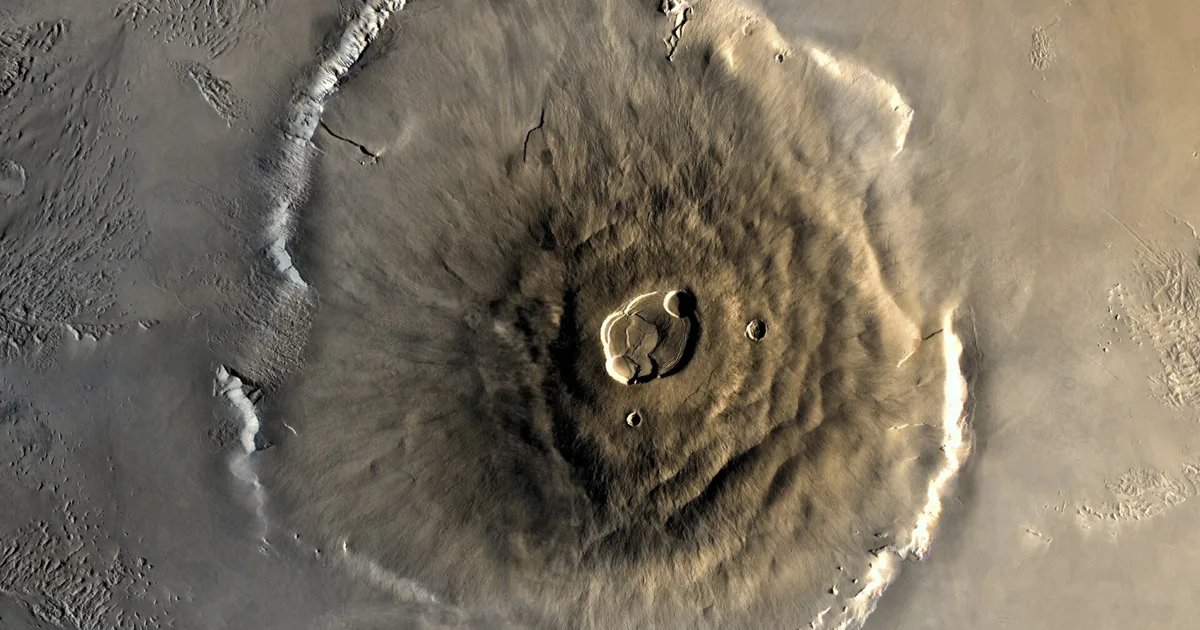
Olympus Mons rises like a colossal dome on the western flank of the Tharsis volcanic plateau. Measured by the Mars Orbiter Laser Altimeter, its summit reaches 21.3 km above the surrounding plain – more than twice the height of Earth’s Mount Everest. This makes it not only the tallest volcano on Mars but also the highest planetary mountain known in the Solar System, rivaling the massive crater rim of Vesta’s Rheasilvia.
Size and Shape: A Martian “Circus Tent”
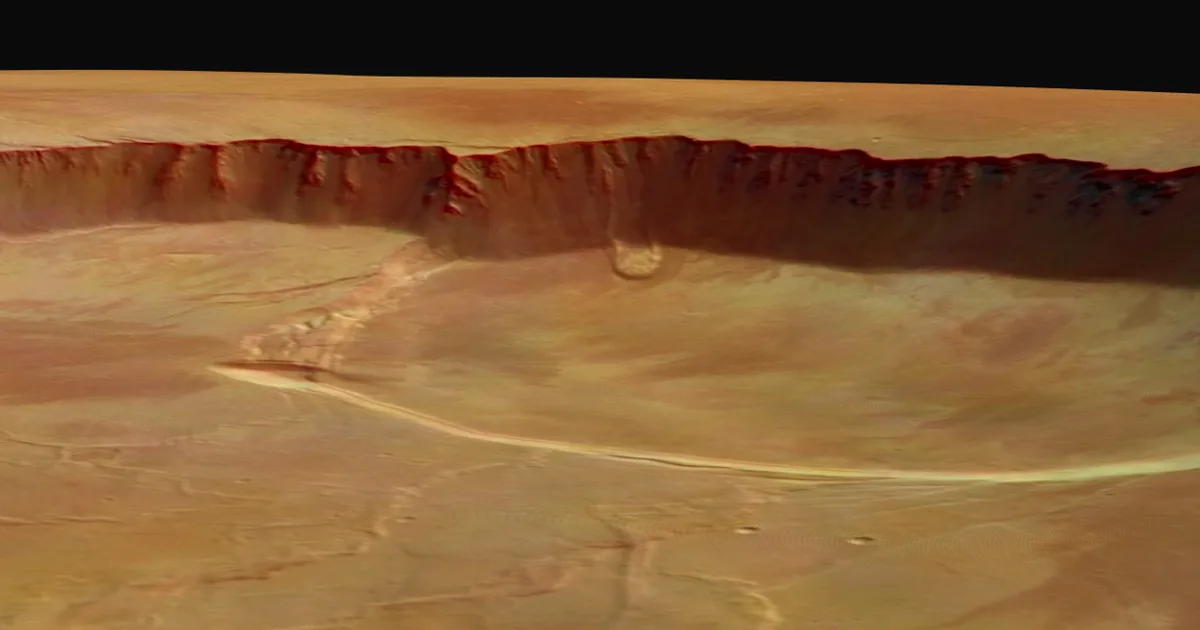
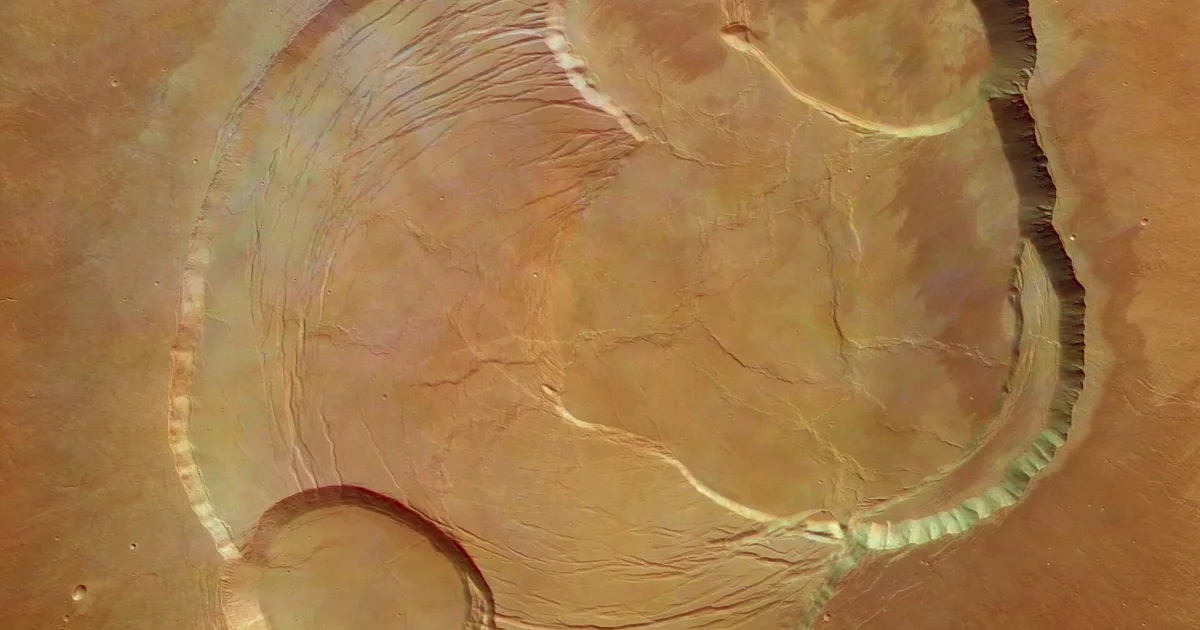
The volcano’s shield‑type profile spreads over a 600 km diameter, covering an area comparable to Italy. Its gently sloping flanks average only a 5 % incline, giving Olympus Mons the appearance of a low‑angle dome or a circus tent held up by a single off‑center pole. Six nested calderas crown the summit, forming an irregular depression about 60 km × 80 km wide and up to 3.2 km deep. A massive escarpment up to 8 km tall marks the north‑western edge, a feature unique among Martian shield volcanoes and likely the result of gigantic flank landslides.
Why Olympus Mons Could Grow So Tall
Two planetary conditions allow Olympus Mons to reach its extraordinary height. First, Mars lacks mobile tectonic plates, so the crust remains fixed over a stationary hotspot. Lava can therefore continue to erupt from the same vent for millions of years, building layer upon layer of basaltic flow. Second, Mars’ gravity is only about 38 % of Earth’s, reducing the downward pull on the accumulating edifice and allowing the volcano to rise higher before its own weight causes collapse.
A Long Volcanic History
Olympus Mons is the youngest of Mars’ large volcanoes. It began forming during the Hesperian period and continued erupting well into the Amazonian period, with the most recent activity dated to roughly 25 million years ago. The volcano’s construction involved thousands of highly fluid basaltic lava flows, similar to those that built the Hawaiian Islands. These flows often developed levees—solidified margins that insulated a hotter, still‑moving core, creating the characteristic channel‑like structures seen in orbital images.
Atmospheric Conditions at the Summit
The summit’s thin air is a stark contrast to Earth’s high mountains. Atmospheric pressure there drops to about 72 Pa, only 12 % of the average Martian surface pressure (≈600 Pa) and a fraction of the 32,000 Pa found on Earth’s Mount Everest. Despite this rarity, high‑altitude orographic clouds occasionally drift over Olympus Mons, and fine Martian dust remains suspended, reminding us that even the highest points on Mars are still part of a planetary atmosphere.
Geological Composition and Surface Materials
Spectroscopic data indicate that Olympus Mons’ surface is composed of roughly 44 % silicates, 17.5 % iron oxides, and notable amounts of magnesium, calcium, aluminium, and a surprisingly high 7 % sulfur dioxide. These proportions point to a basaltic foundation, consistent with low‑viscosity lava that spreads widely and creates the volcano’s gentle slopes. The high sulfur content suggests that volcanic gases once played a significant role in shaping the local environment.
Craters and Martian Meteorites
Two impact craters, Karzok (15.6 km) and Pangboche (10.4 km), sit on Olympus Mons’ flanks. Both have been provisionally named by the International Astronomical Union. Scientists suspect these craters may be source locations for shergottites, the most common class of Martian meteorites that have landed on Earth, offering valuable clues about the volcano’s interior composition.
Looking Ahead: From Olympus Mons to Mushroom Gardens on Mars
Understanding the scale and stability of Olympus Mons helps engineers design habitats that can withstand Martian conditions. As we dream of cultivating mushrooms in the thin Martian air, the volcano’s gentle slopes and vast basaltic plains could one day host the first off‑world mushroom farms, bringing a taste of Earth to the heights of Olympus Mons.
Sources
This article was prepared with AI assistance from the sources listed above and approved by the Mushroom 2 Mars team before publication.