A Colossal Chasm on the Red Planet
Valles Marineris stretches for more than 4,000 km, making it longer than the United States from coast to coast. At its widest it spans roughly 200 km, and in places it plunges up to 7 km deep—taller than Earth’s tallest mountain range. This canyon system runs east‑west along Mars’ equatorial region, just to the east of the massive Tharsis volcanic plateau, and occupies about a quarter of the planet’s circumference.

How the Rift Came to Be
Current consensus holds that Valles Marineris began as a giant rift fault, similar to the East African Rift on Earth. As the Tharsis bulge grew—first from volcanic eruptions and the uplift of the crust—the added weight caused the surrounding crust to stretch and crack. Over time, these fractures widened, and the canyon walls collapsed, creating the deep, sprawling system we see today. Subsequent erosion—by wind, landslides, and possibly ancient flows of water or carbon dioxide—further carved the canyon.
The Role of Tharsis Volcanoes
The formation of Valles Marineris is tightly linked to the development of the Tharsis region, which hosts Olympus Mons, the Solar System’s tallest volcano. Early in Mars’ history (the Noachian to Late Hesperian periods), repeated eruptions of low‑viscosity magma built up a huge volcanic plateau. Because Mars lacks active plate tectonics, the same volcanic hotspots stayed active for millions of years, creating enormous shield volcanoes. The immense load of these volcanoes eventually caused the crust to fracture, giving rise to the Valles Marineris rift.
Landslides and Surface Changes
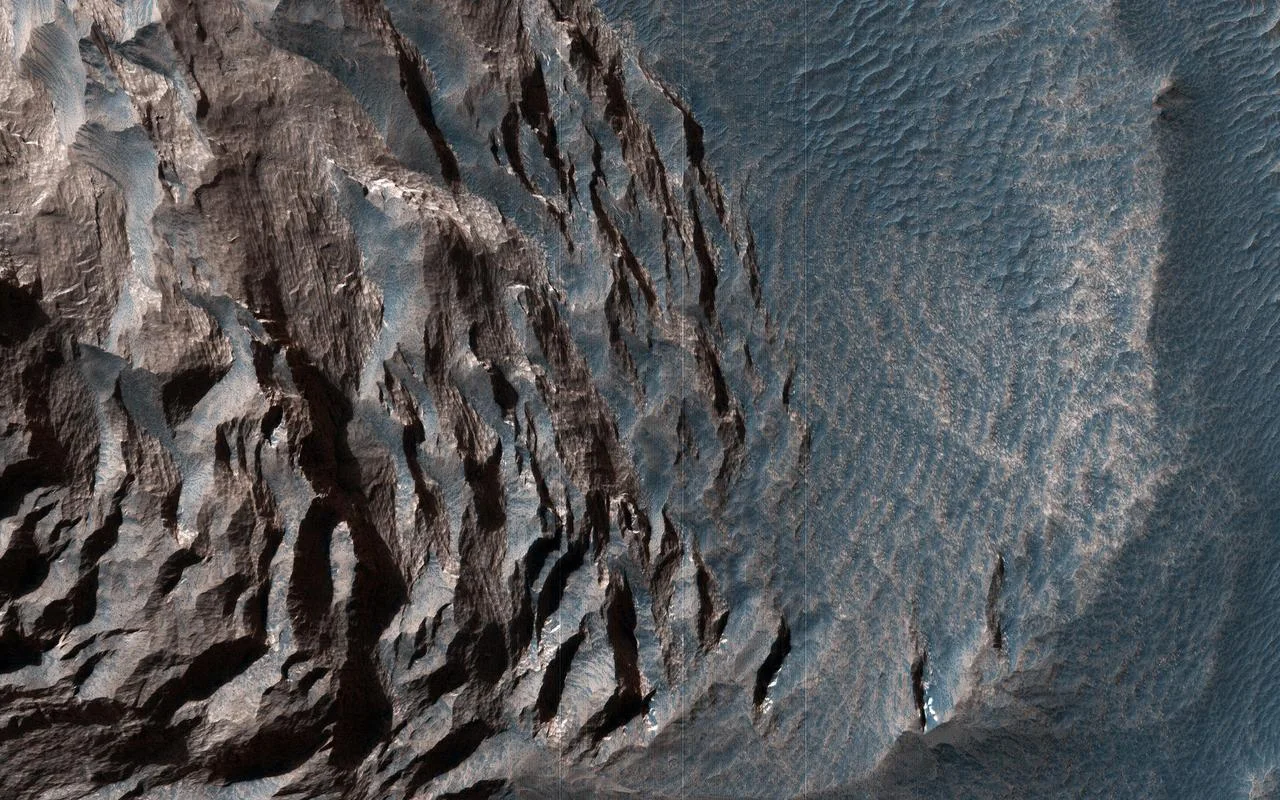
The canyon floor is littered with deposits left by landslides, which have helped widen the chasm over billions of years. Some of these slides may have been triggered by marsquakes—seismic events caused by tectonic stresses or impacts. While Mars is far less tectonically active than Earth, evidence suggests that a few relatively recent impacts, such as the formation of the Oudemans crater, could have generated enough shaking to destabilize canyon walls.
A Patchwork of Sub‑Regions
Valles Marineris is not a single trench but a network of interconnected chasms. Starting in the west, the system begins with Noctis Labyrinthus, a maze‑like area of fractured blocks and mixed terrains. Moving eastward, the canyon splits into several named chasmata—Tithonium, Ius, Melas, Candor, Ophir, Coprates, Ganges, Capri, and Eos—each with its own distinct geology. The eastern terminus opens onto chaotic outflow channels that lead toward the Chryse Planitia basin, a low‑lying plain that once hosted large standing bodies of water.
What the Past Might Have Looked Like
Early hypotheses in the 1970s suggested that flowing liquid water carved the canyon, a plausible idea given that Mars once possessed a thicker atmosphere and warmer climate. While today’s thin air and low temperatures prevent stable liquid water, many scientists agree that ancient rivers or floods could have contributed to widening Valles Marineris during Mars’ early epochs. Other theories, such as the withdrawal of subsurface magma or purely tectonic stretching, have also been explored, reflecting the complexity of Mars’ geological history.
Why Valles Marineris Matters for Future Exploration
Understanding how Valles Marineris formed helps researchers piece together the broader story of Mars’ interior and climate evolution. The canyon’s exposed layers act like a natural cross‑section, revealing rock strata that span billions of years. Future missions may target these walls for drilling or sample return, seeking clues about past habitability. And for us back on Earth, the sheer scale of Valles Marineris reminds us of the dynamic forces that shape planetary surfaces—knowledge that can inform everything from Earth‑based geology to the design of habitats for growing mushrooms on Martian terrain.
Sources
This article was prepared with AI assistance from the sources listed above and approved by the Mushroom 2 Mars team before publication.