Part of the guide: Mycology: A Complete Guide to Fungi, Cultivation, and Safety
A Tiny Nest on the Forest Floor
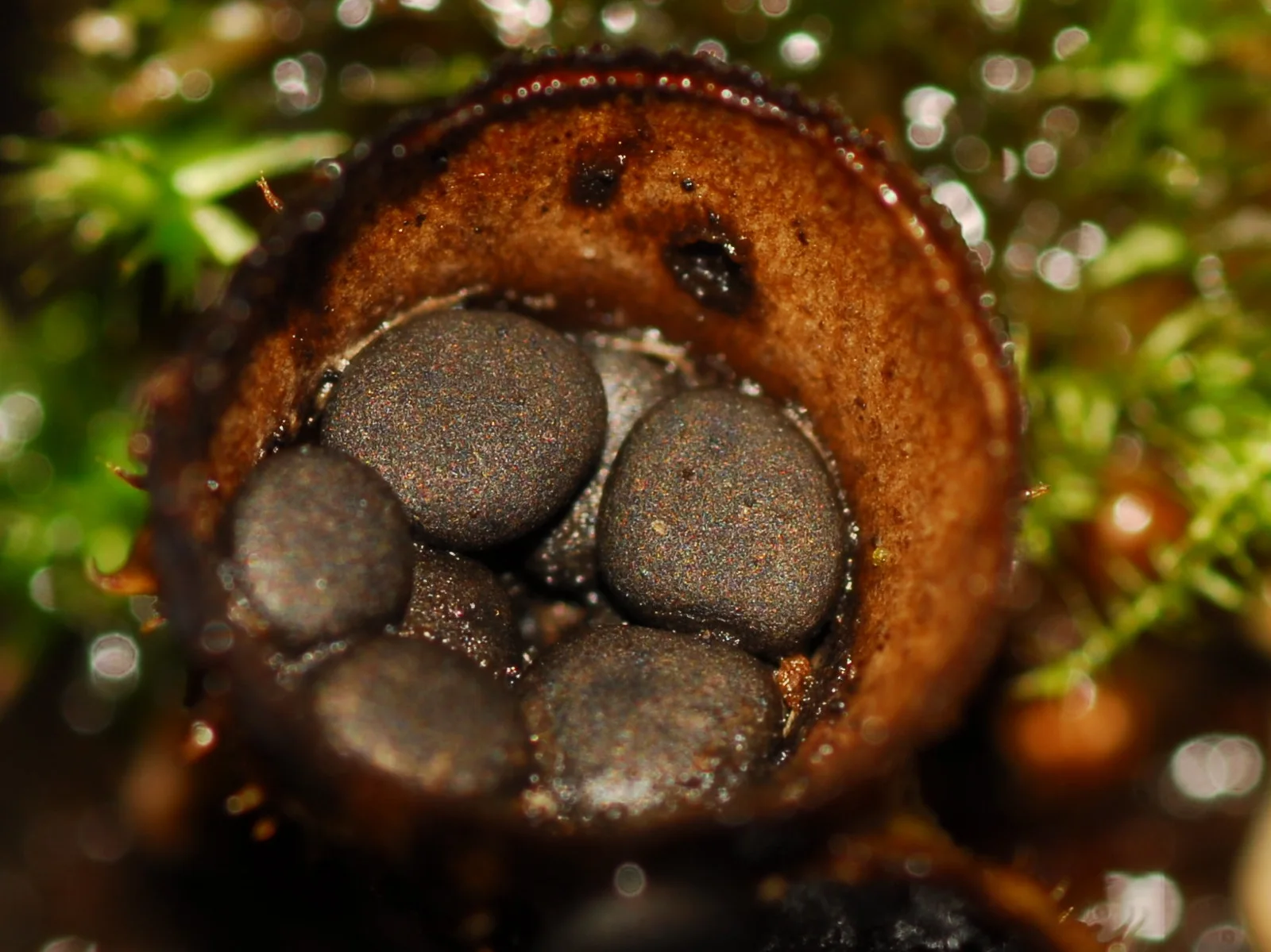
Cyathus stercoreus, often called the dung‑loving bird’s nest, belongs to the family Nidulariaceae. Its fruiting bodies look like miniature nests holding tiny black "eggs"—the peridioles. These cups range from 6 to 15 mm tall and 4 to 8 mm wide, with a golden‑brown to blackish‑brown exterior that darkens with age. The outer wall (ectoperidium) is covered in shaggy hyphal tufts that may wear away on older specimens, while the inner wall (endoperidium) stays smooth and grey‑to‑bluish‑black. Inside, each cup typically contains about twenty peridioles, each 1–2 mm in diameter.
How the Nest Throws Its Eggs
The most striking feature of C. stercoreus is its splash‑cup spore‑dispersal system. When a raindrop strikes the cup at the right angle and speed, the impact ejects the peridioles into the air. The force also tears open a tiny purse‑like sheath (the upper part of the funiculus) and releases a coiled funicular cord that unravels like a spring. This cord, made of thick, rope‑like hyphae, remains highly elastic and sticky, helping the peridiole adhere to nearby vegetation after launch. This clever mechanism maximizes the distance the spores travel, often several centimeters—a remarkable feat for a fungus only a few millimetres across.
Inside the Cup: Microscopic Architecture
Scanning‑electron and transmission‑electron microscopy have revealed a sophisticated hyphal network. The outer and inner cup walls consist of thick‑walled, unbranched skeletal hyphae that give the structure strength and elasticity. The hapteron—a tangled mass of hyphae at the cup’s interior—anchors the funicular cord, while the cord itself is composed of twisted, rope‑like hyphae that can withstand considerable tension. This microscopic scaffolding supports the rapid expansion of the cord during a splash event, ensuring the peridioles are launched efficiently.
Light‑Guided Development
Although the fungus thrives on dung, its fruiting bodies are surprisingly sensitive to light. Laboratory studies show that exposure to wavelengths shorter than 530 nm is required for fruiting to occur, and the cups tend to orient toward the light source—a behavior known as positive phototropism. Researchers suggest that limited nutrients may trigger the production of a “photoreceptive precursor,” making the mycelium responsive to light cues. This light dependence explains the wide variety of cup shapes and colours observed in nature, as different light intensities and spectra shape development.
The Full Life Cycle
Cyathus stercoreus follows the typical basidiomycete cycle, alternating between haploid and dikaryotic stages. Spores released from peridioles germinate into homokaryotic hyphae (each cell containing a single nucleus). When two compatible hyphae meet, they fuse in plasmogamy, forming a dikaryotic mycelium that can eventually produce fruiting bodies after about 40 days under laboratory conditions. Within the peridioles, basidia develop, each bearing two haploid nuclei that fuse, undergo meiosis, and generate new basidiospores—ready to be splashed away by the next rain.
Global Reach and Habitat Preferences
True to its name, C. stercoreus is coprophilous, preferring dung or dung‑enriched soil, but it also appears on bonfire sites and even sand dunes. Its distribution is truly cosmopolitan; early mycologists noted that it probably occurs wherever manure is present. This adaptability, combined with its efficient spore‑shot system, helps the species colonize new substrates across continents.
From Earth to the Red Planet?
Understanding the biology of resilient fungi like the dung‑loving bird’s nest informs broader efforts to cultivate life‑supporting organisms beyond Earth. The fungus’s ability to thrive on nutrient‑poor substrates and its reliance on simple water and light cues make it a candidate for experimental growth in controlled Martian habitats, where waste recycling and minimal resource inputs are essential.
Sources
This article is for general information only and is not medical advice. Do not use it to diagnose or treat any condition; talk to a doctor about health questions.
This article was prepared with AI assistance from the sources listed above and approved by the Mushroom 2 Mars team before publication.