A Massive Martian Cliff
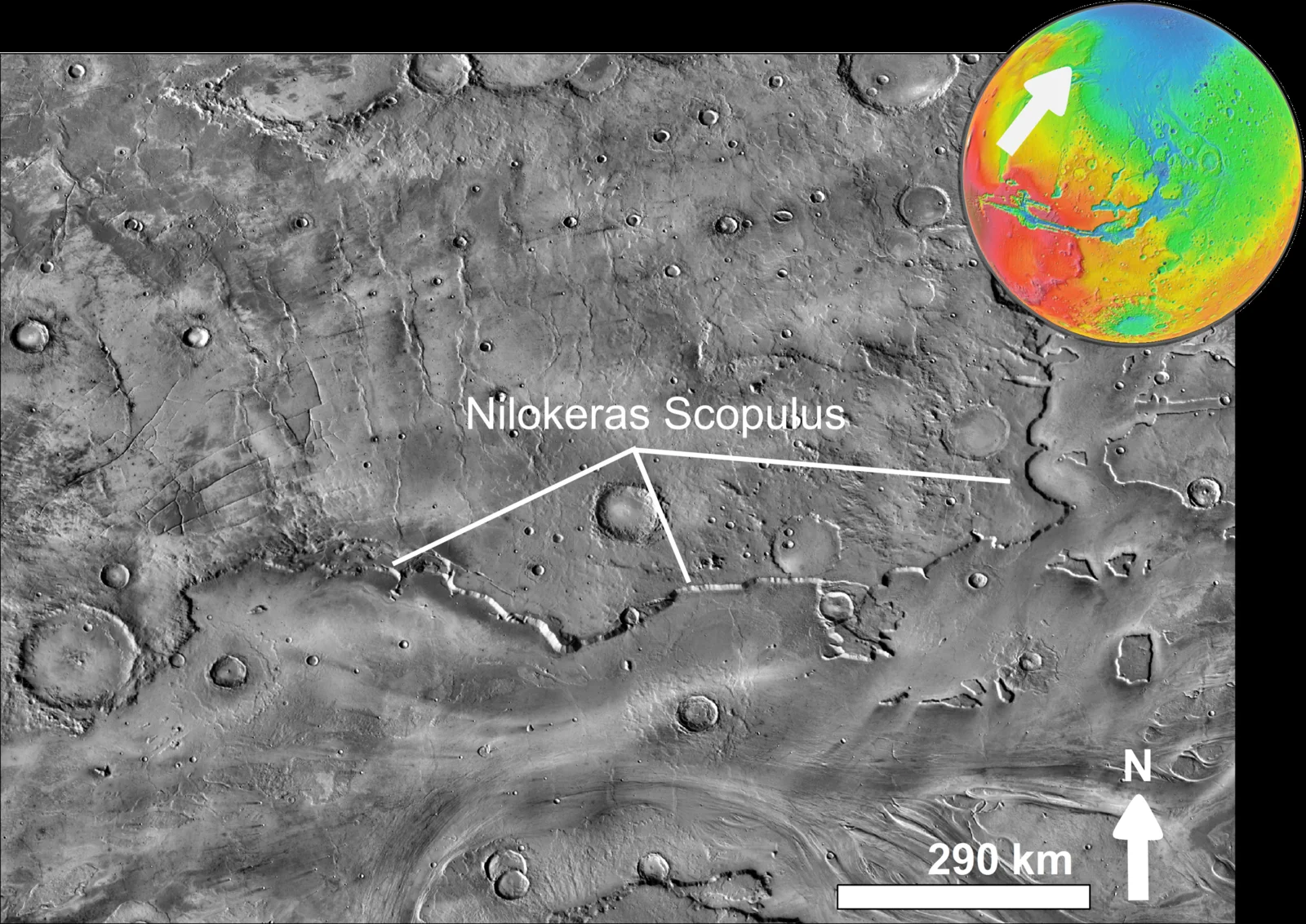
Nilokeras Scopulus stretches for about 765 km along the northern edge of the Tempe Terra plateau on Mars. Its sheer face rises between 1 km and just over 2 km, making it one of the planet’s most prominent escarpments. The feature runs roughly west‑to‑east between 31° and 32° N latitude, curving northward where the Kasei Valles outflow channel empties into the Chryse and Acidalia plains.
Naming the Crag
The name combines a Greek word and a Latin descriptor. In 1930, astronomer E. M. Antoniadi used the term “Nilokeras” – meaning “horn of the Nile” – for a bright albedo feature near 30° N, 55° W. The International Astronomical Union (IAU) later added the term Scopulus, Latin for “crag” or cliff, to create the official name Nilokeras Scopulus in 1976.
How the Escarpment Formed
An escarpment can arise from tectonic movement, erosion, or deposition, and Nilokeras Scopulus likely reflects a mix of these processes. Early in Mars’ history, a fault or fracture zone ran east‑west across what is now southern Tempe Terra. Massive floodwaters that carved the Kasei Valles—originating from the northern Tharsis region—eroded this weakness, deepening the scarp. These cataclysmic floods occurred during the Hesperian period, roughly 3.6 to 3.4 billion years ago.
Layers of Time: Lava, Floods, and Glaciers
After the initial flooding, the region was blanketed by basaltic lava flows from Tharsis during the late Hesperian. Later, in the Amazonian era (less than 1.8 billion years ago), additional floods from the Echus Chasma region cut new channels south of the escarpment. While these younger floods reshaped the surrounding valleys, they left the main face of Nilokeras Scopulus largely intact.
The cliff’s surface bears evidence of later modification. Glacial and periglacial activity, groundwater sapping, slumping, and other mass‑wasting processes have altered its appearance. High‑resolution images from orbiters reveal layered bedrock at the top of the scarp, overlain by talus aprons and a fine dust mantle.
The Rock Record
The rocks exposed on Nilokeras Scopulus date back to the Noachian or early Hesperian epochs, making them older than 3.6 billion years. They are thought to consist of ancient impact breccias—rock fragments fused together by meteor impacts—and volcanic materials. Such ancient materials provide a window into the early crustal composition of Mars and the planet’s violent formative years.
Why It Matters for Mars Science
Studying Nilokeras Scopulus helps scientists understand how large‑scale flooding and tectonic forces shaped Mars’ surface. The escarpment serves as a natural cross‑section of the planet’s geological history, preserving clues about early water activity, volcanic resurfacing, and later climate‑driven processes. By mapping its layers and assessing the distribution of talus and dust, researchers refine models of erosion rates and the longevity of Martian landforms.
From Cliffs to Colonies
While the cliff itself is a relic of ancient Mars, its towering walls inspire modern imagination. In the context of the Mushroom 2 Mars project, the sheer faces of features like Nilokeras Scopulus remind us that any future habitat or greenhouse will need to contend with dramatic topography and the legacy of water‑shaped landscapes.
In the end, Nilokeras Scopulus stands as a testament to Mars’ dynamic past and a striking backdrop for any dream of growing mushrooms on the Red Planet.
Sources
This article was prepared with AI assistance from the sources listed above and approved by the Mushroom 2 Mars team before publication.