A Cloud Unlike Any Other on Mars
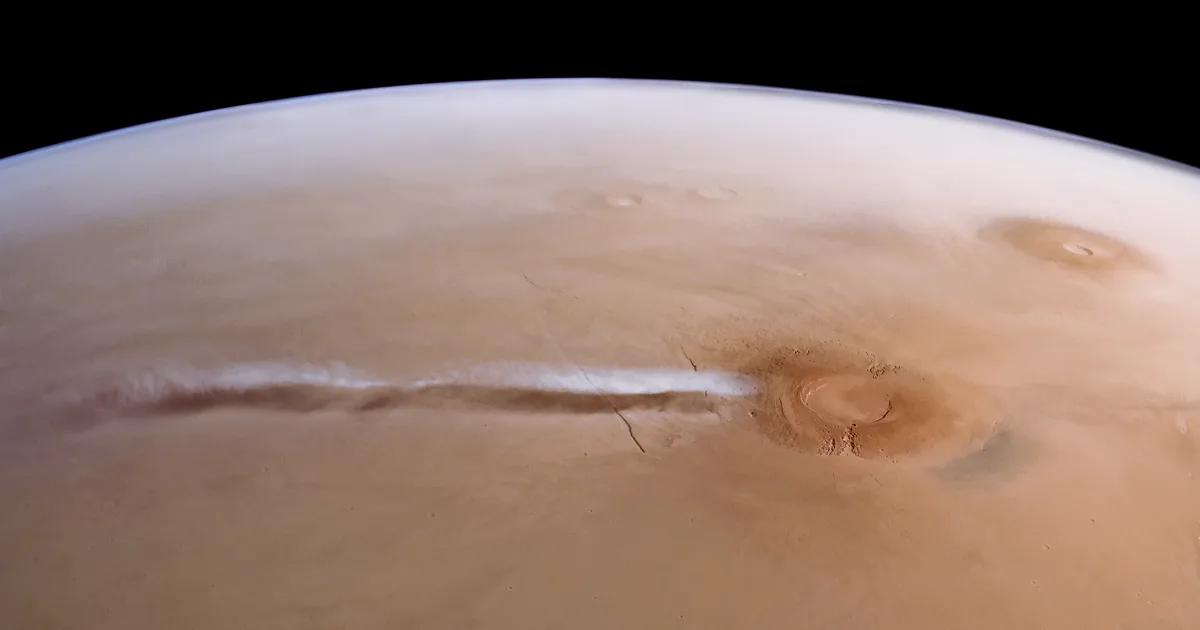
Every spring and summer in the southern hemisphere of Mars, a spectacular white ribbon stretches across the sky downwind of the towering Arsia Mons volcano. This feature, known as the Arsia Mons Elongated Cloud (AMEC), can reach lengths of up to 1,800 km—almost twice the width of the United Kingdom—before it evaporates in the morning light. First spotted by ESA’s Mars Express in 2018, the cloud appears daily for several months, forming, growing, and fading on a timescale of hours.
From Mystery to Model: Adding “Exotic” Physics
Scientists have long classified the AMEC as an orographic cloud, a type that forms when winds are forced over a mountain or volcano. However, attempts to reproduce the cloud’s behaviour in atmospheric models fell short—until researchers introduced a rarely‑considered physical process. Lead author Jorge Hernández‑Bernal (LMD/CNRS/Sorbonne Université) explains that the key was to allow homogeneous nucleation of ice, a mechanism that textbooks treat as theoretical and seldom observed in nature. When this process was included, the model generated a cloud that matched the observed AMEC remarkably well.
What Is Homogeneous Nucleation?
On Earth, cloud droplets usually form by heterogeneous nucleation: water vapor condenses onto tiny particles such as dust, salt, or soot. Mars’s thin atmosphere makes dust the most likely catalyst there as well. The AMEC, however, appears to bypass this step entirely. According to the study, water vapor in the Martian atmosphere can freeze directly into ice crystals without any solid surface to cling to—much like droplets forming in the middle of a still room rather than on a window pane. This homogeneous ice nucleation has never been witnessed in a planetary atmosphere before.
How the Volcano Triggers the Rare Process
The conditions required for homogeneous nucleation are extreme. Relative humidity must exceed normal Earth values by a factor of over 100,000, and temperatures must drop rapidly. The combination of Mars’s thin air and the 20‑km‑high Arsia Mons volcano creates just such an environment. As winds sweep over the volcano’s bulk, they generate a powerful atmospheric wave that lifts moist air parcels several kilometres upward in minutes. This rapid ascent cools the air by about 30 °C in ten minutes, causing humidity to spike and water vapor to freeze spontaneously into ice particles, giving rise to the AMEC.
Mars Express: A Unique Eye on Morning Clouds
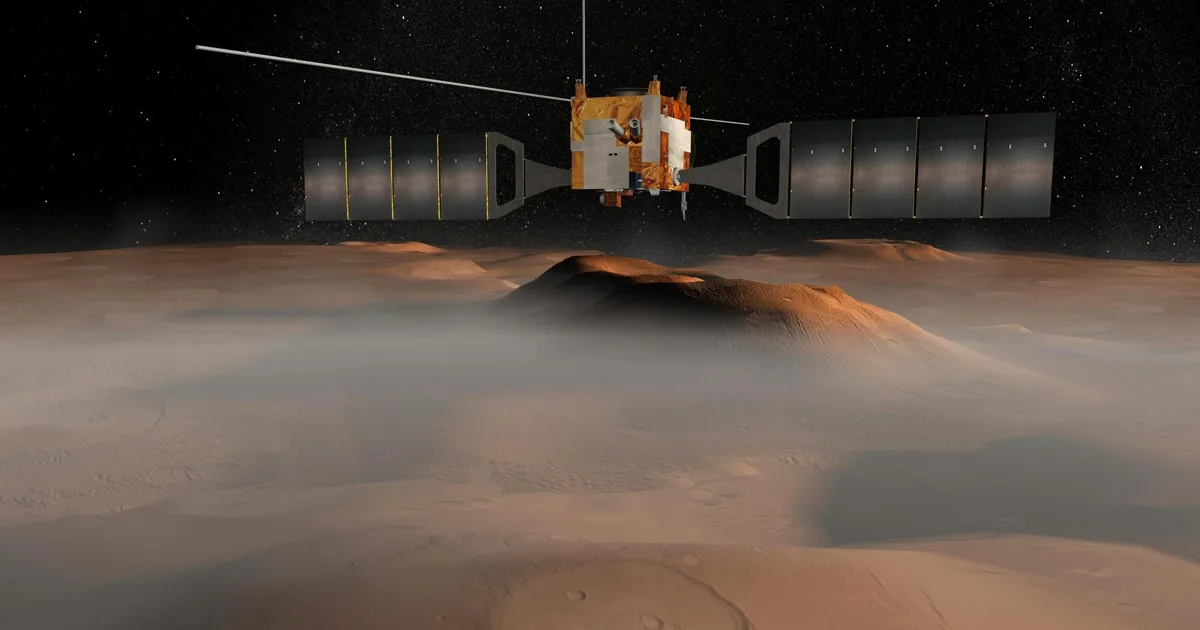
Mars Express’s three imaging instruments—the Visual Monitoring Camera (VMC), the High‑Resolution Stereo Camera (HRSC), and the OMEGA spectrometer—have been crucial for this discovery. Unlike most orbiters, Mars Express can observe the planet during the early morning, when the AMEC is most prominent. The spacecraft can track the cloud’s evolution on hourly timescales, providing an unprecedented view of a short‑lived Martian phenomenon. Project scientist Colin Wilson notes that reproducing the cloud in a model, even partially, is a major achievement given the limited data we have on the Red Planet’s atmosphere.
Why This Matters Beyond Mars
The finding underscores that planetary atmospheres may host processes we consider unlikely. If homogeneous nucleation can occur on Mars under the right circumstances, similar exotic mechanisms might be at play on other worlds, including exoplanets with thin atmospheres and dramatic topography. Understanding these out‑of‑the‑ordinary processes helps refine climate models for a wide range of planetary environments.
From a mushroom‑farming perspective, the lesson is clear: even the most unexpected physics can shape a world’s climate—something our future Martian farms will have to keep in mind as we aim to grow fungi under alien skies.
Sources
This article was prepared with AI assistance from the sources listed above and approved by the Mushroom 2 Mars team before publication.