A Pioneer Among European Space Missions
Mars Express marked ESA’s first foray into planetary exploration when it launched in 2003. Designed for speed and efficiency, the spacecraft took advantage of a rare close alignment of Earth and Mars – the closest in roughly 60,000 years – to reach the Red Planet in just a few months. Since entering orbit in early 2004, the orbiter has become a workhorse for scientific observation, outlasting many contemporaries and earning multiple mission extensions that now keep it operational through at least the end of 2026, with a provisional stretch to 2028.

The Dual‑Purpose Architecture: Orbiter and Beagle 2
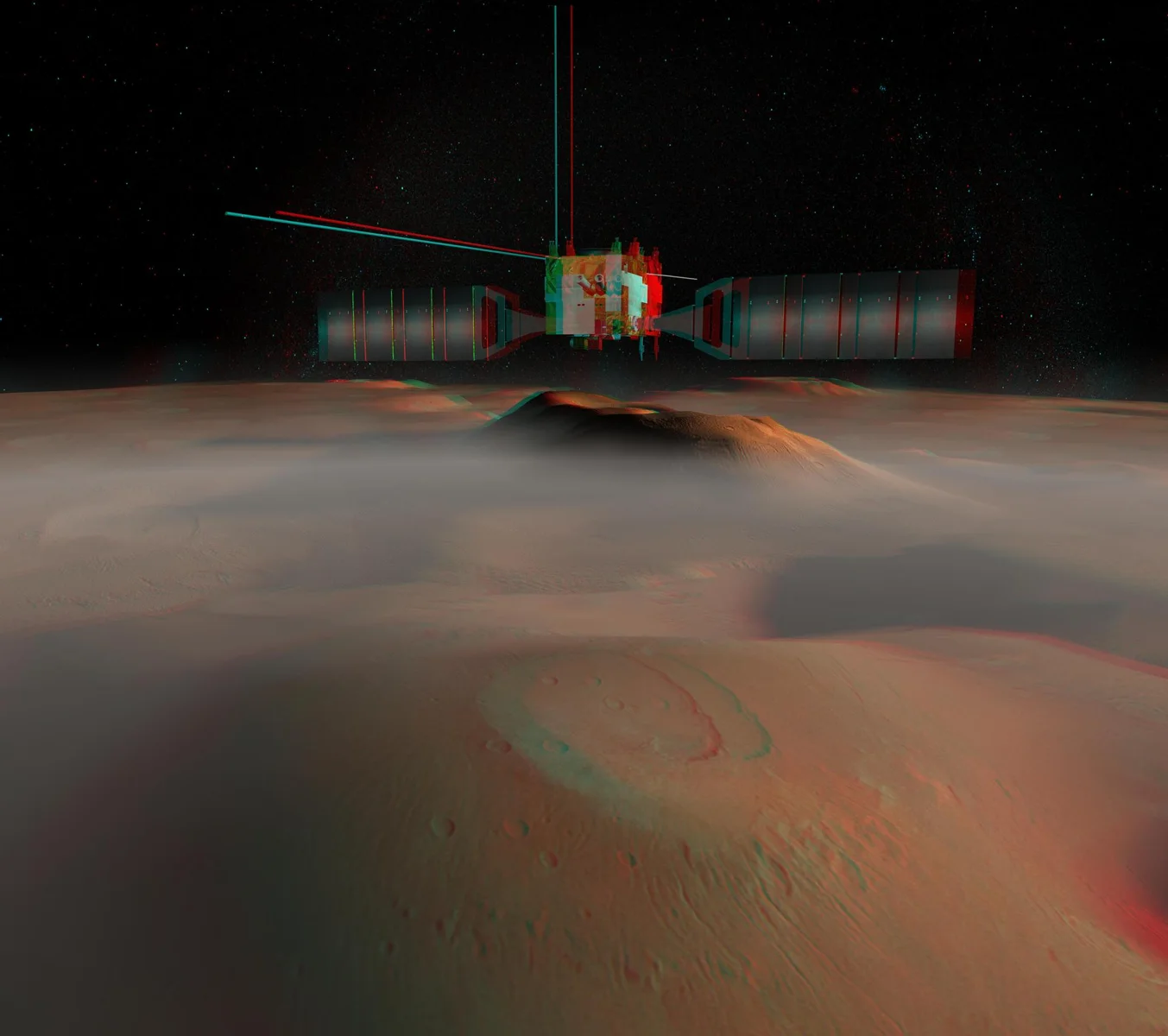
The mission comprised two main elements. The primary spacecraft is the Mars Express Orbiter, equipped with seven scientific instruments that map surface mineralogy, capture high‑resolution images, and probe the subsurface with radar. A secondary payload, the Beagle 2 lander, was intended to conduct exobiology and geochemistry experiments on the surface. Although Beagle 2 failed to fully deploy its solar panels after landing, the orbiter has continued to deliver valuable data, including detailed radar soundings that reveal layers of permafrost beneath the Martian crust.
Scientific Toolbox: Instruments and Measurements
The orbiter’s payload includes a high‑resolution camera system, spectrometers that identify minerals, and a radar sounder capable of looking up to several kilometres below the surface. These tools have helped scientists track seasonal changes in atmospheric composition, map water‑bearing minerals, and study how the thin Martian atmosphere interacts with solar wind and interplanetary space. The spacecraft also conducts radio occultation experiments, providing precise measurements of atmospheric pressure and temperature profiles.
Power, Propulsion, and Precision Pointing
Power comes from two solar panels spanning about 12 m tip‑to‑tip, delivering roughly 460 W after a wiring fault reduced the originally planned 660 W. Energy is stored in three lithium‑ion batteries for eclipse periods. Propulsion relies on a 400 N bipropellant main engine and eight 10 N thrusters for trajectory corrections, while eight reaction wheels, star cameras, and sun sensors keep the spacecraft’s pointing accuracy within 0.04° of an inertial reference frame. Such precision is essential for the narrow‑field instruments that require stable observation platforms.
A Communications Hub in Martian Orbit
Beyond its scientific role, Mars Express serves as a central relay node for other missions. It has facilitated radio links for ESA’s Trace Gas Orbiter, China’s Zhurong rover, and is slated to support Japan’s upcoming Martian Moons eXploration (MMX) sample‑return mission. The spacecraft’s high‑gain antenna and dipole antennas enable data transmission back to Earth and inter‑spacecraft communication, making it a vital part of the growing Mars network.
Legacy and Ongoing Contributions
After more than two decades, Mars Express remains the second‑longest‑running spacecraft in orbit around another planet, surpassed only by NASA’s 2001 Mars Odyssey. Its longevity stems from a robust design inherited from ESA’s Rosetta and Venus Express missions, which emphasized reliability and cost‑effective development. The mission’s extended timeline has allowed researchers to monitor long‑term climate trends on Mars, refine models of subsurface ice distribution, and support international collaboration across multiple agencies.
Looking ahead, the data gathered by Mars Express will continue to inform future habitats – perhaps even the mushroom‑farming modules that Mushroom 2 Mars envisions for life on the Red Planet.
Sources
This article was prepared with AI assistance from the sources listed above and approved by the Mushroom 2 Mars team before publication.