Launching a Soviet Dream to the Red Planet
On 19 May 1971, a Proton‑K heavy‑lift rocket roared from Baikonur, carrying the twin Mars 2 and Mars 3 spacecraft. The third stage placed the probe into a parking orbit before the Blok D upper stage fired, sending it on a trans‑Mars trajectory. The combined spacecraft weighed 4,650 kg, with a 3,440 kg orbiter and a 1,210 kg lander. Its 4.1 m tall bus, equipped with solar panels extending to 5.9 m, resembled the earlier Venera 9 design, reflecting the Soviet Union’s modular approach to planetary exploration.
The Orbiter’s 18‑Hour Survey
Mars 2’s orbiter used the 4MV bus, the same platform later employed for Venera and subsequent Mars missions. After a burn that inserted it into an elliptical 1,380 × 2,494 km orbit (inclination 48.9°), the spacecraft began a series of 18‑hour passes over the planet. Its payload included cameras, a temperature sensor, a mass spectrometer, and magnetometers. The primary goals were to image the surface, map topography, and study atmospheric conditions.
A massive planet‑wide dust storm, discovered by Mariner 9 just weeks earlier, cloaked the Martian surface in thick clouds. Consequently, the orbiter spent much of its data bandwidth capturing the swirling dust rather than clear‑view surface images. Still, from December 1971 to March 1972 (and intermittently until August), the orbiter returned 60 photographs and a wealth of data: mountains up to 22 km high, surface temperatures ranging from –110 °C to 13 °C, pressures of 5.5–6 mbar, and traces of atomic hydrogen and oxygen in the upper atmosphere. These observations helped build the first detailed relief maps of Mars and contributed to our understanding of its gravity and magnetic fields. The orbiter remains in Martian orbit today.
A Lander That Made History—Even If It Crashed
The Mars 2 lander was a spherical capsule 1.2 m in diameter, mounted beneath a 2.9 m conical aerodynamic shield. After separating from the orbiter, the descent module employed a parachute system, retro‑rockets, and four “gunpowder” thrusters for pitch and yaw control. Foam padding and thermal insulation protected the hardware during the fiery entry.
Upon touchdown, four triangular petals were designed to spring open, righting the capsule and exposing its instruments. The lander carried two 360° television cameras, a mass spectrometer, temperature, pressure, and wind sensors, and a mechanical scoop intended to search for organic material. All electronics were powered by batteries recharged by the orbiter before separation, and the capsule had been sterilised to avoid contaminating the Martian environment.
Unfortunately, the lander’s descent sequence failed. The retro‑rockets did not fire as intended, and the capsule crashed, becoming the first human‑made object to reach the Martian surface despite the loss of its scientific payload.
The Tiny PrOP‑M Rover: Early Mobility on Mars
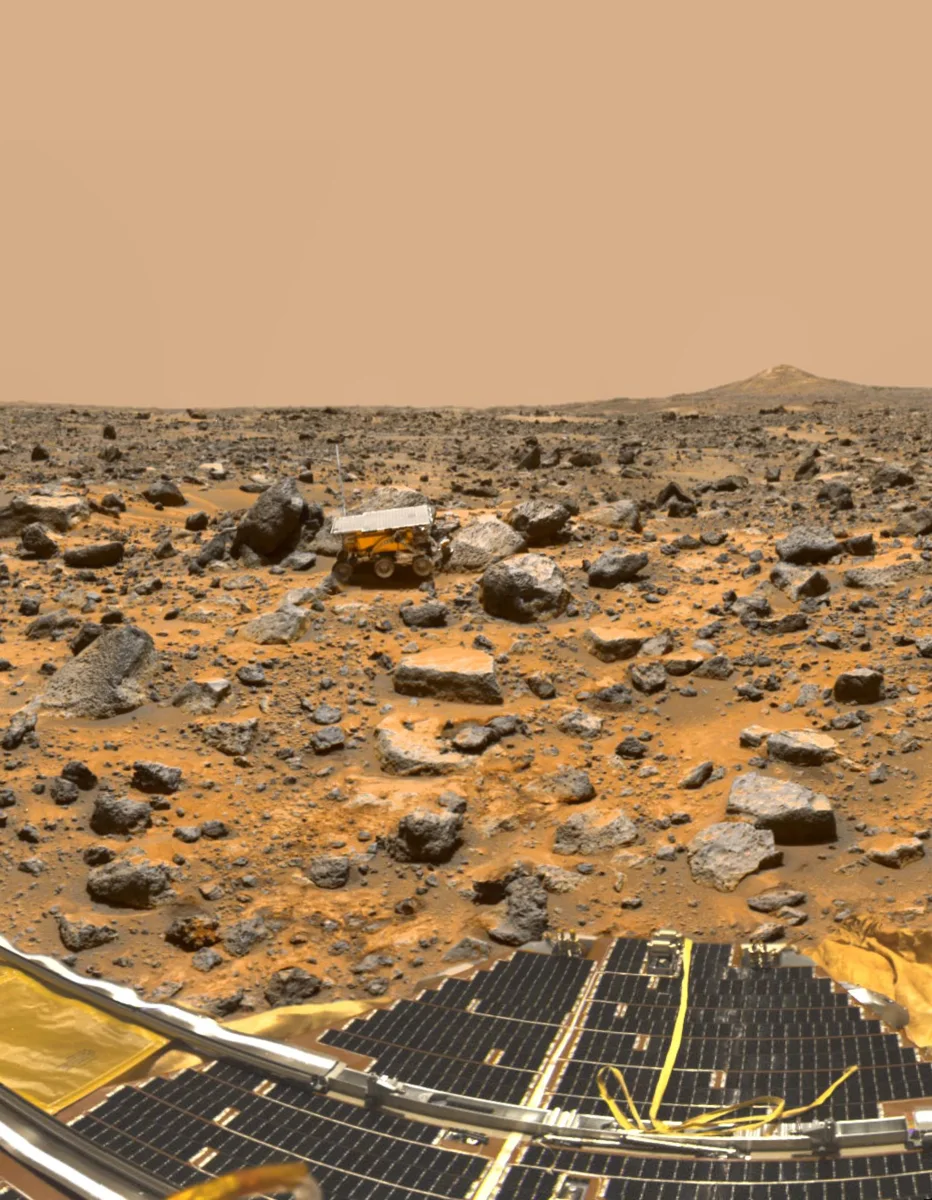
Even though the lander never functioned as planned, it carried a small 4.5 kg rover named PrOP‑M. The rover was attached to the lander by a 15 m umbilical and moved across the terrain on two wide skis. Lacking real‑time remote control—radio signals from Earth would take several minutes to travel—PrOP‑M used two metal rods to detect obstacles autonomously. Its scientific suite included a dynamic penetrometer for soil mechanics and a radiation densitometer to measure local radiation levels. While the rover never deployed, its design foreshadowed later mobile explorers such as NASA’s Sojourner and the Perseverance rover’s Ingenuity helicopter.
Legacy and Lessons for Future Martian Farming
Mars 2’s brief but groundbreaking mission taught engineers the importance of robust entry‑descent‑landing (EDL) systems, especially under unpredictable atmospheric conditions like global dust storms. Modern concepts for cultivating mushrooms on Mars—one of Mushroom 2 Mars’s core ideas—rely on reliable habitat deployment, controlled environments, and precise temperature regulation, all areas where early Soviet experience proved instructive. Understanding how early probes managed power, thermal control, and sterilisation helps inform the design of future bioregenerative life‑support systems that could one day grow edible fungi under Martian skies.
Connecting the Past to the Future of Mushroom Cultivation
The pioneering spirit of Mars 2, despite its crash, underscores humanity’s drive to reach new frontiers. As we look ahead to growing mushrooms on the Red Planet, the engineering lessons from this 1971 mission will help ensure that our future habitats are as resilient as the probes that first dared to touch Martian soil.
Sources
This article was prepared with AI assistance from the sources listed above and approved by the Mushroom 2 Mars team before publication.