A Twisting Tale in the Solar Wind
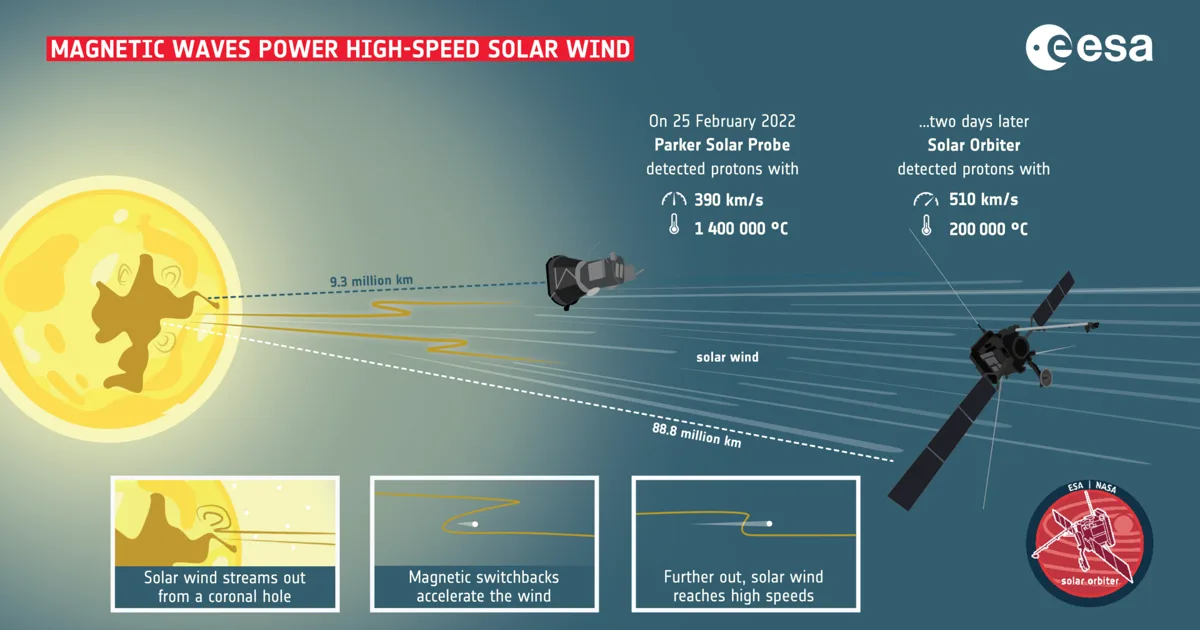
The solar wind is a constant stream of hot, charged particles that flows outward from the Sun, dragging its magnetic field along like invisible threads. Occasionally, these magnetic field lines form sharp, S‑shaped bends known as magnetic switchbacks. First spotted by ESA’s Solar Orbiter in 2022, switchbacks have puzzled scientists for years. Why do they appear, and what do they tell us about the Sun’s restless magnetism?

Seeing the Switchback Shape Directly
During a recent close pass, Solar Orbiter flew straight through a massive switchback. Using its Solar Wind Analyser (SWA), the spacecraft measured the plasma inside the kink and confirmed the long‑predicted S‑shaped geometry. This direct observation was a milestone because earlier missions could only infer the shape from indirect data.
Fingerprinting the Plasma
The real breakthrough came from the particle “fingerprints” recorded by SWA. The instrument detected a distinctive mix of ionised oxygen and carbon that can only form inside hot magnetic loops on the Sun’s surface. As lead author Jesse Coburn (CNRS/LPP, France) explains, this composition is a smoking‑gun for a formation process called interchange reconnection.
Interchange Reconnection: Opening Closed Loops
The Sun’s magnetic landscape consists of open field lines that stretch outward like highways and closed loops that arch back to the surface. When an open region meets a closed one, the field lines can crowd together, snap, and reconnect. This reconnection releases plasma that was previously trapped in a loop, flinging it into space. The particles measured inside the switchback match exactly what would be expected from such a release.
Waves, Turbulence, and a Two‑Stage Story
Not everyone agreed that reconnection alone could explain every switchback. Some researchers pointed to waves and turbulence—random, chaotic motions that can also bend magnetic fields. Co‑author Stephanie Yardley (Northumbria University, UK) notes that after the switchback leaves the Sun, these wave‑driven processes dominate its subsequent journey. The new findings suggest a two‑stage model: interchange reconnection creates the kink, then waves and turbulence shape its evolution as it travels through the heliosphere.
Connecting Sun to Space Weather
Understanding how switchbacks form matters beyond academic curiosity. The solar wind links Earth to the Sun, and its magnetic turbulence can amplify solar storms that threaten satellites, power grids, and astronauts. By linking a switchback’s particle signature back to a specific solar region, scientists gain a new tool for reading the solar wind’s history and potentially forecasting hazardous space‑weather events.
The Role of Solar Orbiter
Solar Orbiter’s unique orbit—halfway between Earth and the Sun—and its suite of instruments made this discovery possible. No other spacecraft currently combines the proximity and the high‑resolution plasma measurements needed to trace a switchback back to its source. As ESA project scientist Daniel Müller says, each new insight helps us protect the technologies we rely on both on Earth and in orbit.
Looking Ahead: From Switchbacks to Martian Mushrooms
While the Sun’s magnetic twists may seem far removed from mushroom farming, the same principles of plasma physics guide the design of future habitats on Mars. Understanding solar wind behavior will be crucial for shielding Martian greenhouses—like those envisioned by the Mushroom 2 Mars project—from harmful radiation, ensuring our fungal friends can thrive on the Red Planet.
Sources
This article was prepared with AI assistance from the sources listed above and approved by the Mushroom 2 Mars team before publication.