Part of the guide: Mushrooms: A Complete Guide to Identification, Cooking, and Cultivation
A Bright Beginning: The Egg Stage
Phallus rubicundus starts life as a compact, whitish "egg" about 2–3 cm long. The egg is gelatinous and attached to the ground by a cord‑like rhizomorph that links it to the underlying mycelium. Multiple eggs may appear together, each arising from a shared network of fungal threads.
Emerging Structure: Stalk and Cap
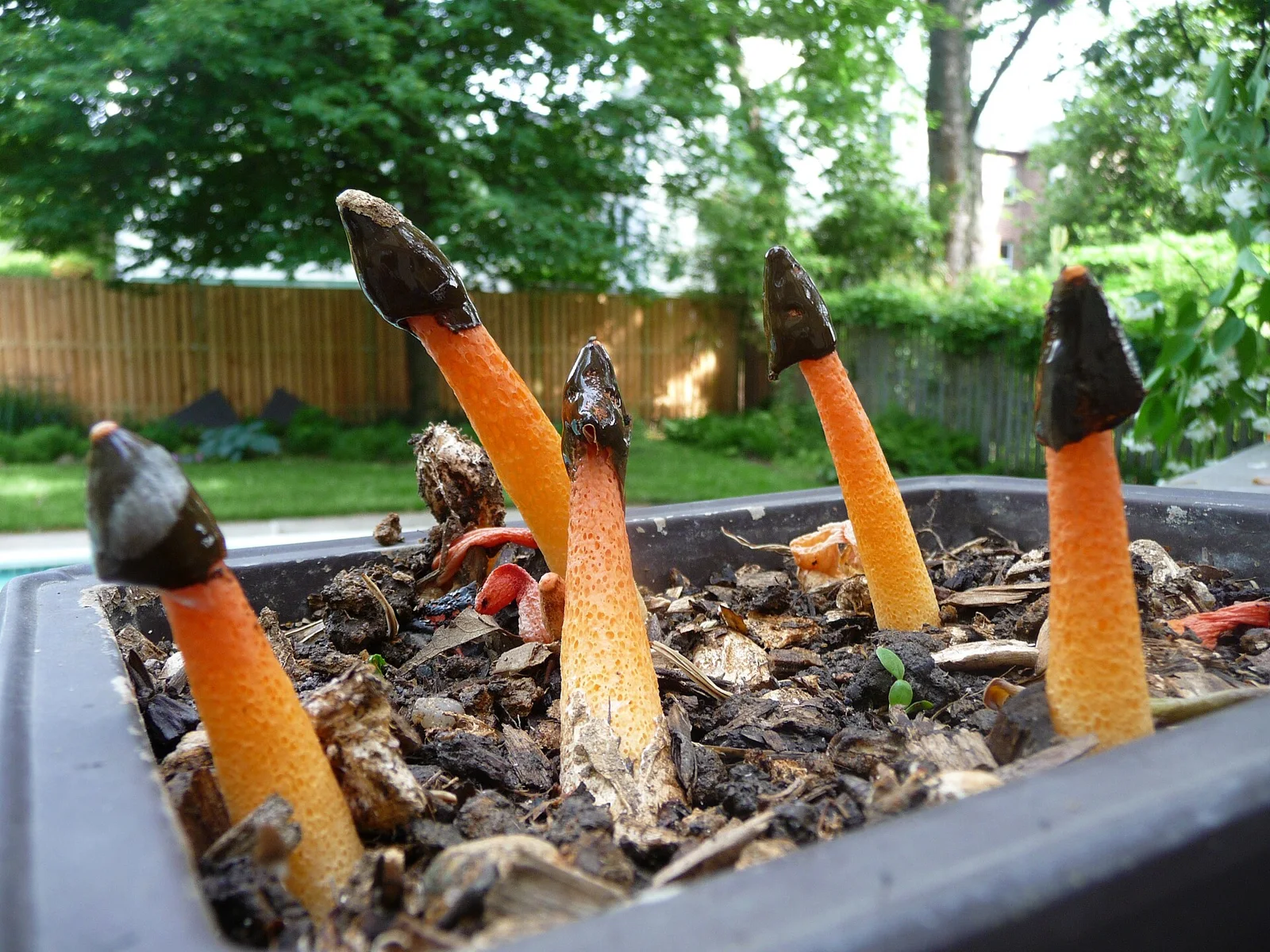
When conditions are right, the egg ruptures and a hollow, orange‑to‑scarlet stalk shoots upward, reaching up to 15 cm tall. The stalk tapers toward the apex and bears a pitted surface. Atop the stalk sits a conical, scarlet‑red cap about 2–3 cm high. The cap is initially cloaked in a slimy, gray‑olive gleba that emits a strong, foul odor.
The Smelly Strategy: Gleba and Spore Dispersal
The gleba’s odor attracts insects, especially flies and mosquitoes, which land on the sticky surface, become coated with spores, and carry them away. Research has shown that mosquitoes drawn to the gleba often die after ingesting it, suggesting a possible avenue for biocontrol research. The spores themselves are smooth, elliptical, and measure roughly 3.6–4.2 µm by 1.6–2.0 µm.
Global Footprint: Where It Grows
Phallus rubicundus thrives in sandy soils, lawns, and mulched garden beds. Its saprobic nature lets it decompose organic matter, making it common in well‑manured areas. The fungus is native to tropical regions and has been recorded across a wide swath of the world: - North America: Southern and eastern United States, including Hawaii. - Australia: Tropical and subtropical zones with abundant mulch. - Asia: China, Japan, Korea, India, Thailand. - Africa: Ghana, Nigeria, Congo, Kenya, South Africa. - South America & Caribbean: Argentina, Brazil, and several Caribbean islands. Its spread is likely aided by the global trade of wood mulch and other landscaping materials.
Cultural Interactions and Traditional Uses
Indigenous groups have incorporated Phallus rubicundus into folk medicine. In India’s Madhya Pradesh, the Bharia and Baiga tribes grind the fungus and mix it with sugar, administering a small dose three times daily for ailments such as typhoid and labor pain. Aboriginal Australians have reportedly used the mushroom as an aphrodisiac, though scientific validation is lacking. These practices illustrate how local knowledge often explores the bioactive potential of fungi.
Distinguishing Features: Avoiding Confusion
Field identification can be tricky. Phallus rubicundus is sometimes mistaken for Mutinus elegans, which lacks a distinct cap and bears its gleba only at the tip of a pointed stalk. Another look‑alike is Satyrus rugulosus, which differs in cap shape and surface texture. Careful observation of the cap’s conical form and the separate, pitted stalk helps separate the scarlet stinkhorn from its relatives.
From Earth to the Red Planet
While Phallus rubicundus is a terrestrial decomposer, its ability to thrive in nutrient‑poor, mulched soils offers clues for designing resilient fungal systems that could support future mushroom cultivation on Mars.
Sources
This article is for general information only and is not medical advice. Do not use it to diagnose or treat any condition; talk to a doctor about health questions.
This article was prepared with AI assistance from the sources listed above and approved by the Mushroom 2 Mars team before publication.