Part of the guide: Mushrooms: A Complete Guide to Identification, Cooking, and Cultivation
A Brief Overview of the Tumbling Puffball
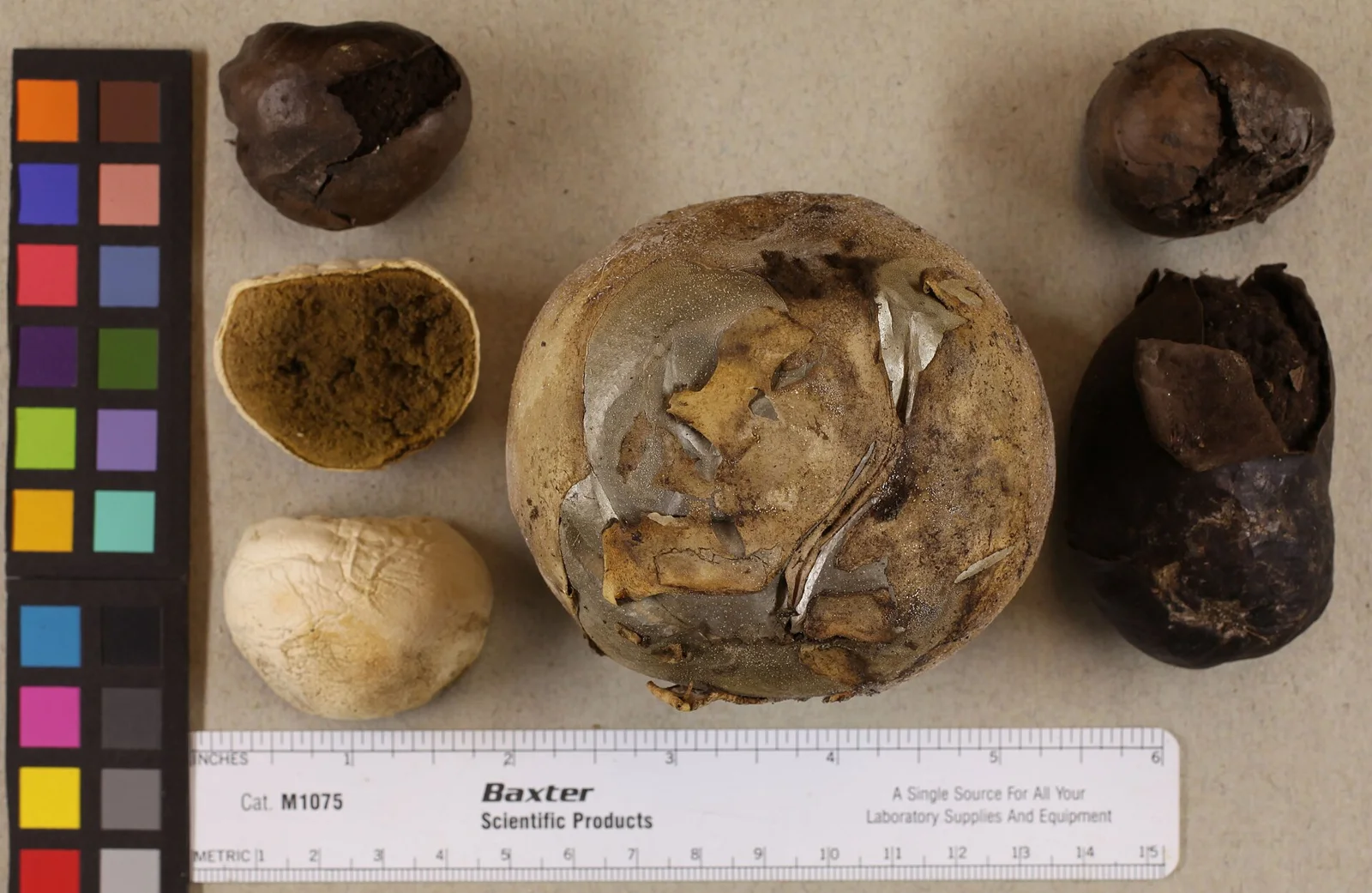
Bovista pila, commonly called the tumbling puffball, belongs to the family Lycoperdaceae. It forms an egg‑shaped to nearly spherical fruit body that can reach up to 8 cm (about 3 in) in diameter. When young, the outer skin – a thin, white to pink exoperidium – looks flaky, almost like tiny pieces of bran. As the puffball matures, this outer layer peels away, revealing a smooth, metallic‑bronze inner skin (the endoperidium) that gives the species its distinctive shine. A short cord, or rhizomorph, attaches the puffball to the ground; once the puffball is fully mature, the cord breaks, allowing the ball to be blown across the landscape – hence the name “tumbling.”
Microscopic Signature: Spores and Capillitia
The true diagnostic characters of B. pila lie under the microscope. Its spores are nearly spherical, 3.5–4.5 µm across, with thick walls and only very short tube‑like extensions (pedicels) that often break off early. The basidia are club‑shaped, usually bearing four spores each, and the sterile fibers (capillitia) form loose, ball‑shaped aggregates about 2 mm in diameter. These microscopic features reliably separate B. pila from the look‑alike European species B. nigrescens, whose spores are oval, rougher, and have longer pedicels.
Where It Grows: Habitat and Distribution
B. pila is a temperate fungus most often encountered across North America, from the United States and Canada to Hawaii. It prefers open, grassy sites such as pastures, lawns, roadside verges, and the edges of woods. The puffballs may appear singly, scattered, or in small groups directly on the soil. Fruiting can continue throughout the typical mushroom season, and the spore cases are durable enough to persist over winter, ready to release new spores when conditions improve.
Outside North America, documented records are sparse. A few specimens have been reported from Russia’s Sakha Republic, the Galápagos Islands, and Brazil’s Pernambuco and São Paulo states, though some of these may represent immature material that is difficult to confirm without microscopic analysis.
Edibility: When the Inside Is White and Firm
When the gleba (the internal flesh) is still white, firm, and free of any greenish or brown coloration, young B. pila puffballs are considered edible. The texture is soft and mild‑flavored, making them suitable for sautéing, adding to soups, or using as a filler in vegetarian dishes. As the puffball ages, the gleba turns greenish and then brown as spores develop, at which point it is no longer suitable for culinary use. For safety, always verify that the interior is uniformly white; any discoloration may indicate that the spores have begun to mature, which can cause digestive upset.
Safety note: Never consume wild mushrooms unless you are absolutely certain of the identification. When in doubt, consult a local mycological society or an experienced forager.
Cultural Footprints: From Chippewa Charms to Livestock Care
Indigenous peoples have long recognized the symbolic value of B. pila. The Chippewa of North America used the puffball as a charm, believing it could bring protection or good fortune. In western Canada, the same species was employed in ethnoveterinary practices, where it was incorporated into traditional remedies for livestock. While modern scientific studies on these uses are limited, the historical record highlights the close relationship between people and this humble fungus.
Taxonomic History: From 19th‑Century Description to Modern Synonyms
The species was first described in 1873 by mycologists Miles Joseph Berkeley and Moses Ashley Curtis, based on specimens collected in Wisconsin. Their original notes emphasized the short pedicels on the spores, a trait that remains a key identifier today. Over the years, several synonyms have appeared in the literature, including Bovista tabacina (Saccardo, 1882) and Mycenastrum oregonense (Ellis & Everhart, 1885). Despite these name changes, modern databases such as MycoBank consolidate them under the accepted name Bovista pila.
Growing Thoughts: From Earth’s Pastures to Martian Greenhouses
The resilient nature of B. pila – its ability to detach, roll, and continue dispersing spores – offers inspiration for closed‑loop mushroom cultivation systems envisioned for future Martian habitats. By studying how this puffball survives in open, variable environments, researchers can design cultivation modules that maximize spore dispersal and resource efficiency, a small step toward a thriving fungal ecosystem on the Red Planet.
The tumbling puffball’s story reminds us that even the simplest fungi can bridge cultures, cuisines, and the frontier of space.
Sources
This guide is not a foraging or identification manual. Many edible mushrooms have toxic look-alikes. Never eat a wild mushroom unless an expert has identified it in person.
This article was prepared with AI assistance from the sources listed above and approved by the Mushroom 2 Mars team before publication.