Part of the guide: Mushrooms: A Complete Guide to Identification, Cooking, and Cultivation
Taxonomic background
Boletus violaceofuscus belongs to the large genus Boletus, a group of fleshy, pore‑bearing mushrooms. The species was first described by the Chinese mycologist W.F. Chiu in 1948, placing it among the many Asian boletes that were documented in the mid‑20th century. Molecular work suggests a close relationship with Boletus separans, another bolete found in temperate forests, indicating shared evolutionary traits within the group.
Macroscopic features
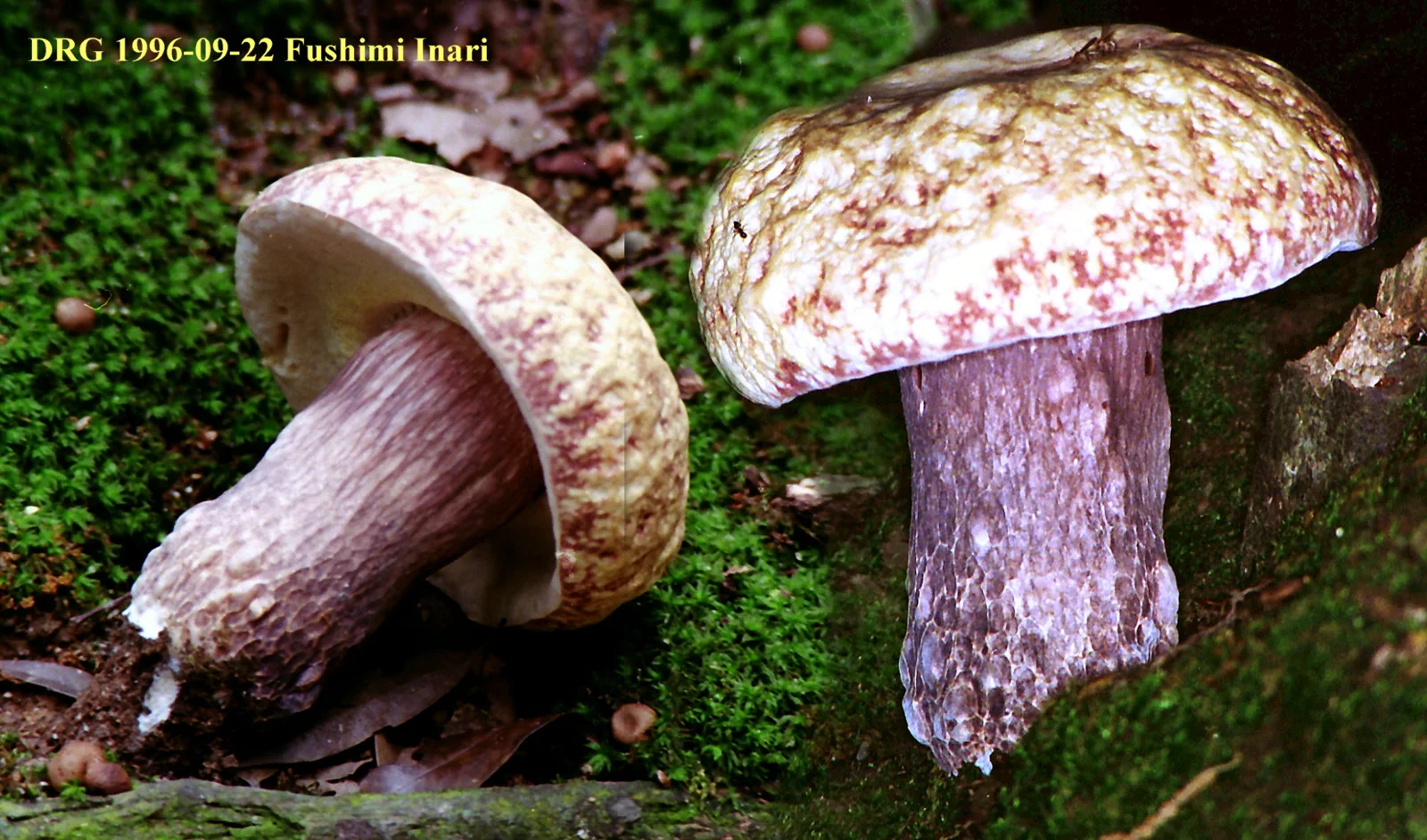
The most striking characteristic of B. violaceofuscus is its cap color. Young specimens display a deep “blue‑violet” hue that can shift toward a muted maroon‑purple as the mushroom ages. Caps range from 4 – 7 cm in diameter, initially hemispherical and later flattening out. The surface is generally smooth, occasionally showing faint wrinkles or a velvety feel. Under the cap, the pore tubes are short (3‑6 mm long) and narrow (0.5‑1 mm wide). When fresh they appear white, turning a pale yellowish tone with maturity or when bruised.
Stipe and flesh
The stipe (stem) measures 5‑7 cm long and 1‑2 cm thick. It is not tightly fused to the cap; instead it narrows near the top before widening toward the middle, a shape typical of many boletes. Its coloration mirrors the cap but is usually a lighter shade, and it is marked by a distinct white reticulation (mesh‑like veins) that can help differentiate it from similar species. The flesh is solid and white, becoming spongier in older specimens. Like many forest mushrooms, it is prone to colonization by insect larvae as it ages.
Microscopic details
Under a microscope, the spores of B. violaceofuscus reveal a green‑gray to olive tint, a useful diagnostic feature for mycologists. Spores are tapered and elliptical, measuring roughly 12‑14 µm in length by 5‑6 µm in width. These dimensions fall within the typical range for Boletus species, aiding identification when macroscopic traits overlap with other boletes.
Habitat and distribution
This bolete is native to China, where it grows in temperate forest ecosystems, often forming mycorrhizal associations with hardwoods. Though detailed ecological studies are limited, its presence alongside other Boletus species suggests a role in nutrient exchange with tree roots, contributing to forest health. The species does not appear in major cultivated mushroom databases, indicating that it remains primarily a wild, regionally specific fungus.
Culinary and safety notes
While many boletes are prized edible mushrooms, the edibility of B. violaceofuscus has not been widely documented in scientific literature or culinary guides. Because its taste, texture, and potential toxins have not been thoroughly evaluated, foragers should treat it as unknown and avoid consumption. Expert identification is essential for any wild mushroom, and consultation with a qualified mycologist is recommended before considering any culinary use.
Looking ahead: From forest floors to future farms
Research into the cultivation of diverse Boletus species is expanding, driven by interest in sustainable protein sources and novel flavors. Understanding the growth requirements of B. violaceofuscus—from soil composition to symbiotic tree partners—could one day enable controlled production, perhaps even in experimental habitats like those envisioned for mushroom farming on Mars.
Sources
This guide is not a foraging or identification manual. Many edible mushrooms have toxic look-alikes. Never eat a wild mushroom unless an expert has identified it in person.
This article was prepared with AI assistance from the sources listed above and approved by the Mushroom 2 Mars team before publication.