Part of the guide: Mushrooms: A Complete Guide to Identification, Cooking, and Cultivation
What Makes a Bovista a "True" Puffball?
Bovista belongs to the family Agaricaceae within the order Agaricales. Unlike many gilled mushrooms, its fruit bodies are globular or pear‑shaped and lack a distinct cap and stem. The outer skin, called the exoperidium, is thin, white to light‑colored, and may be smooth, granular, or finely spiny depending on the species. As the puffball matures, this outer layer flakes away, revealing a smooth inner surface (endoperidium) with a tiny apical pore (the ostiole) through which spores are released.
Spotting Bovista in the Field
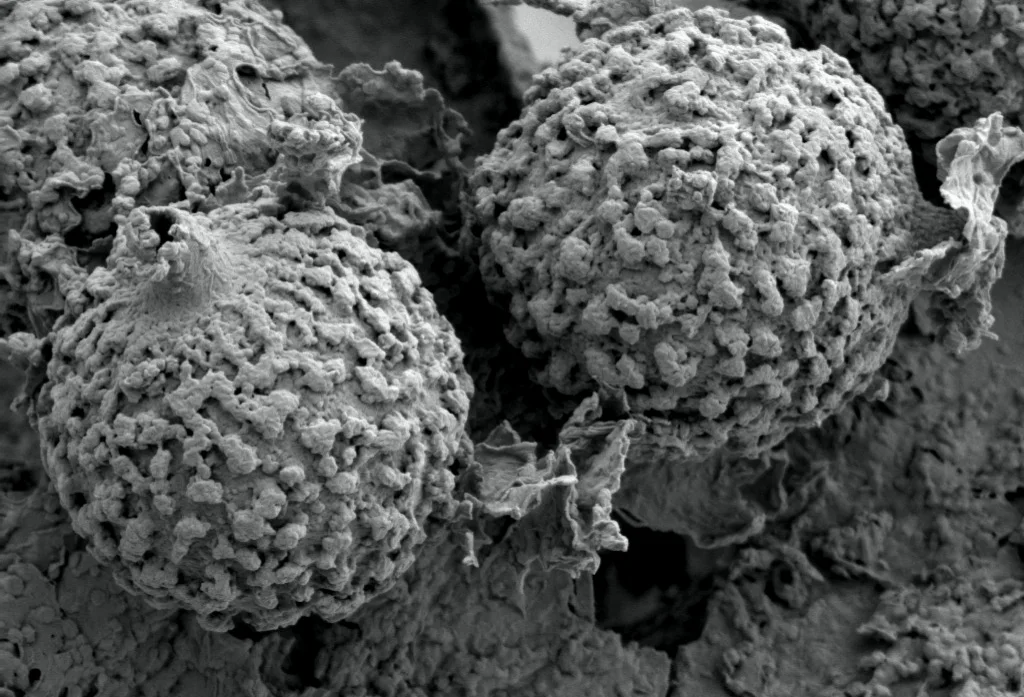
Identifying Bovista safely is essential because young puffballs can look similar to the deadly Amanita species when they are still enclosed. Follow these steps: 1. Size and Shape – Most Bovista fruit bodies range from 1 cm to 8 cm in diameter and are roughly spherical to pear‑shaped. 2. Surface Texture – Examine the exoperidium. Some species are smooth, others feel granular or have tiny prickles (echinulate). 3. Attachment – Look for fine cord‑like rhizomorphs anchoring the puffball to the soil. 4. Cut Test – Slice the mushroom longitudinally. A true Bovista will be uniformly white inside with no internal gills, veins, or embryonic caps. Any sign of darker tissue or developing structures means it is not a safe puffball. 5. Spore Print – When mature, the spores are brown to purple‑brown and roughly spherical, 3.5–7 µm across. The spores are released in a puff when the ostiole is disturbed, often making the puffball behave like a tiny tumbleweed.
Safety note: Always have an experienced mycologist confirm identification before consuming any wild mushroom.
Life Cycle and Ecology
Bovista species are cosmopolitan, thriving in temperate zones across North America, Europe, and Asia. They grow on soil, leaf litter, and occasionally on decaying wood. The fruit bodies develop underground or just at the surface, emerging when ready to release spores. The capillitium—an internal network of thread‑like cells—has a distinctive “Bovista‑type” structure: separate, irregularly branched strands ending in tapered points. This elastic network gives the gleba a cottony feel even after the outer skin has fallen away, aiding spore dispersal by wind.
Molecular studies have reshaped the taxonomy of puffballs. Historically placed in the now‑obsolete order Lycoperdales, DNA analysis moved Bovista into Agaricaceae. Phylogenetic work shows the genus is monophyletic and can be divided into two main clades that roughly match the subgeneric groups Globaria (Lycoperdon‑type capillitium) and Bovista (Bovista‑type or intermediate capillitium).
Culinary Use: When and How to Cook Bovista
Young, white‑inside Bovista puffballs are considered edible. Their mild flavor and soft texture make them a good substitute for more common mushrooms in soups, sautés, and stir‑fries. Follow these guidelines for safe preparation:
- Confirm Edibility – Perform the cut test and ensure the interior is uniformly white. Discard any specimen with discoloration or internal structures.
- Cleaning – Gently brush off soil with a soft brush. Rinse quickly under cool water if needed; avoid soaking, which can make the flesh soggy.
- Slicing – Cut the puffball into ½‑inch (1.3 cm) thick slices. Smaller pieces cook more evenly.
- Cooking Method – Heat a skillet with 1–2 tablespoons of oil or butter over medium heat. Add the slices and sauté for 3–4 minutes per side until golden brown. The interior should become opaque and firm.
- Seasoning – Simple salt, pepper, and fresh herbs (such as thyme or parsley) complement the subtle flavor. For a vegan twist, finish with a splash of soy sauce or miso‑based glaze.
- Safety – Cook to an internal temperature of at least 74 °C (165 °F) to ensure any hidden microbes are destroyed.
Because Bovista is a puffball, it lacks the complex umami compounds found in many gilled mushrooms, so pairing it with richer sauces or broth can enhance its taste.
Historical and Cultural Footnotes
The genus was first described by Dutch mycologist Christiaan Hendrik Persoon in 1794. Over the centuries, several synonyms appeared, including Piesmycus and Globaria. In the 19th century, Bovista spores entered the realm of homeopathy. Texts from that era claimed the spores could affect blood flow and were used for a wide range of ailments—from menstrual irregularities to “asphyxiation” after charcoal inhalation. Modern science does not support these therapeutic claims, and they are presented here only as a historical curiosity.
From Earth to Mars: Why Puffballs Matter
Mushrooms are being studied for life‑support systems in space habitats because they can recycle waste, produce protein, and grow on minimal substrates. The simple, robust structure of puffballs like Bovista makes them interesting candidates for experiments in closed‑loop ecosystems—an area where the Mushroom 2 Mars team hopes to learn more about sustainable food production beyond Earth.
All facts are drawn from the Wikipedia entry on Bovista and related mycological literature.
Sources
This guide is not a foraging or identification manual. Many edible mushrooms have toxic look-alikes. Never eat a wild mushroom unless an expert has identified it in person.
This article was prepared with AI assistance from the sources listed above and approved by the Mushroom 2 Mars team before publication.