Part of the guide: Mushrooms: A Complete Guide to Identification, Cooking, and Cultivation
A striking appearance in the understory
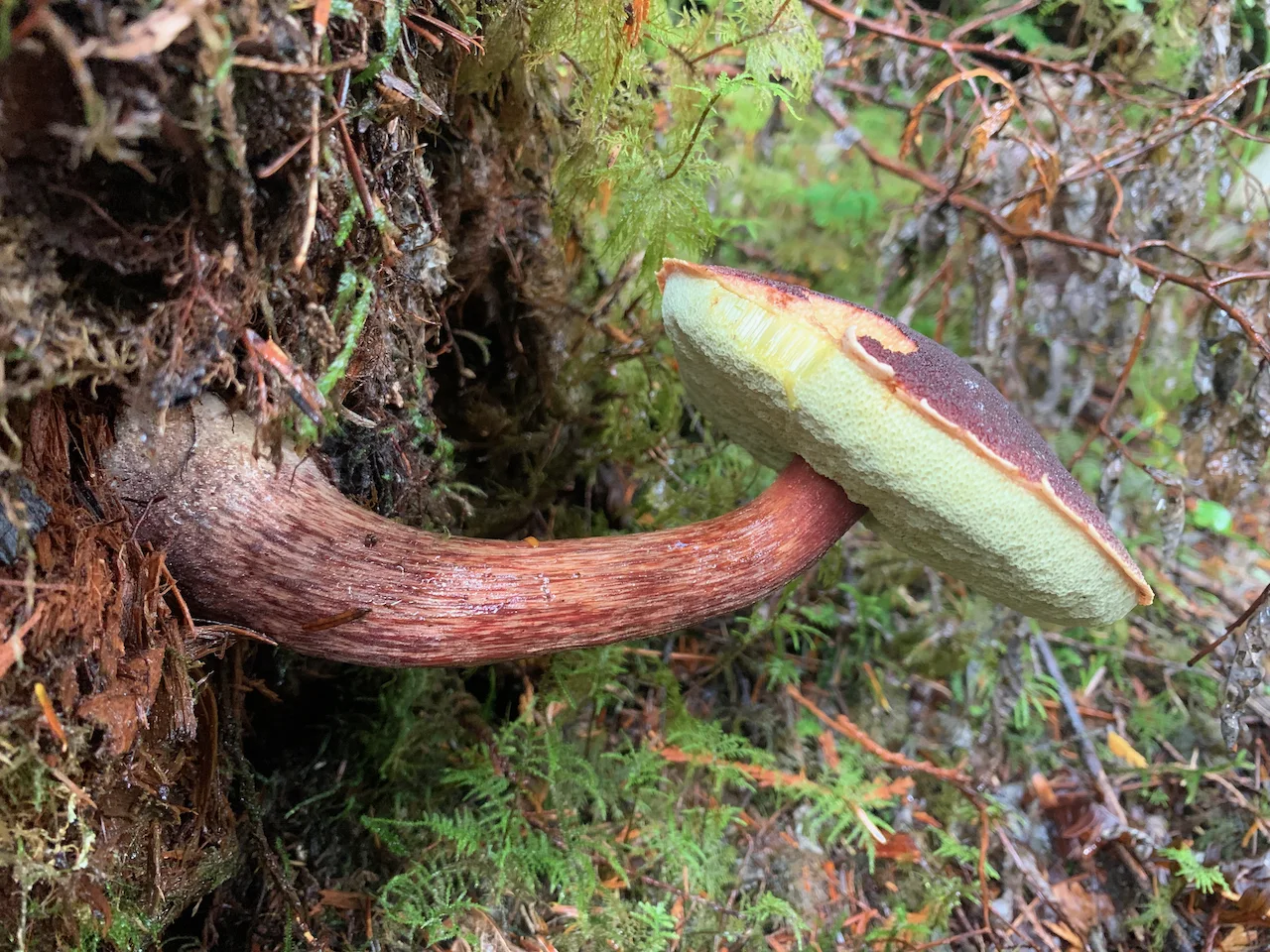
Aureoboletus mirabilis, often called the admirable bolete or velvet top, stands out with a dark reddish‑brown cap that can reach 15 cm (6 in) across. Young caps feel slimy or slippery, while older ones dry to a velvety texture. The surface is covered in fine woolly hairs and may develop cracked, mud‑like patches as the mushroom matures. Beneath the cap lie thick tubes up to 2.5 cm (1 in) long, initially pale yellow and turning greenish‑yellow with age. The pores are relatively large – about 1–2 mm in diameter – giving the underside a spongy look.
Habitat and ecological role
This bolete is most commonly found in coniferous forests along the Pacific Coast of North America and in parts of Asia. It often appears on the wood or woody debris of hemlock trees, which is unusual for boletes that are typically mycorrhizal. Molecular studies, however, confirm that A. mirabilis forms a mycorrhizal partnership with tree roots, exchanging nutrients while still sometimes fruiting on dead wood, suggesting a flexible lifestyle.
Taxonomic twists over a century
The scientific name of the admirable bolete has changed several times. William A. Murrill first described it in 1912 as Ceriomyces mirabilis from specimens near Seattle, Washington, then moved it to Boletus later that year. In 1940 Rolf Singer placed it in Xerocomus, and five years later in Boletellus. Debates continued for decades; Harry D. Thiers argued in 1966 that the species fit better in Boletellus based on spore smoothness and stipe characteristics, only to reverse his view nine years later when spore examinations proved otherwise. The genus Heimioporus was proposed for the species in 2004, but DNA evidence in 2015 finally settled it in Aureoboletus.
Close relatives revealed by DNA
A 2001 ribosomal DNA analysis placed A. mirabilis near well‑known boletes such as Boletus edulis (the king bolete), Phylloporus rhodoxanthus, and Tylopilus felleus within the “boletoid radiation” of the Boletales order. More recent phylogenetic work, using broader taxon sampling, confirms a close relationship to other Aureoboletus species, underscoring how molecular tools have clarified the bolete family tree.
Microscopic clues
Under the microscope the spores appear olive‑brown, smooth, and thick‑walled, measuring about 18–22 µm by 7–9 µm. They are spindle‑shaped to roughly elliptical. The basidia are club‑shaped, hyaline, and typically bear four spores each. These microscopic traits help distinguish A. mirabilis from look‑alikes such as Boletellus species, which often have roughened spores.
Edibility and culinary notes
A. mirabilis is listed as edible. When cooking, treat it like other firm boletes: clean the cap and stem gently, slice, and sauté in butter or oil until the flesh turns golden. Because the pores can bruise to a mustard‑yellow, some foragers prefer to remove the pore layer before cooking. Always verify identification with an expert; wild mushrooms can be confused with toxic look‑alikes, and the admirable bolete should never be harvested from polluted sites.
From forest floor to Mars?
Mushrooms like Aureoboletus mirabilis illustrate the diverse fungal life that could one day be cultivated in closed‑loop habitats on Mars, supporting both nutrition and soil health for future explorers.
Sources
This guide is not a foraging or identification manual. Many edible mushrooms have toxic look-alikes. Never eat a wild mushroom unless an expert has identified it in person.
This article was prepared with AI assistance from the sources listed above and approved by the Mushroom 2 Mars team before publication.