Part of the guide: Mycology: A Complete Guide to Fungi, Cultivation, and Safety
A Giant of the Forest Canopy
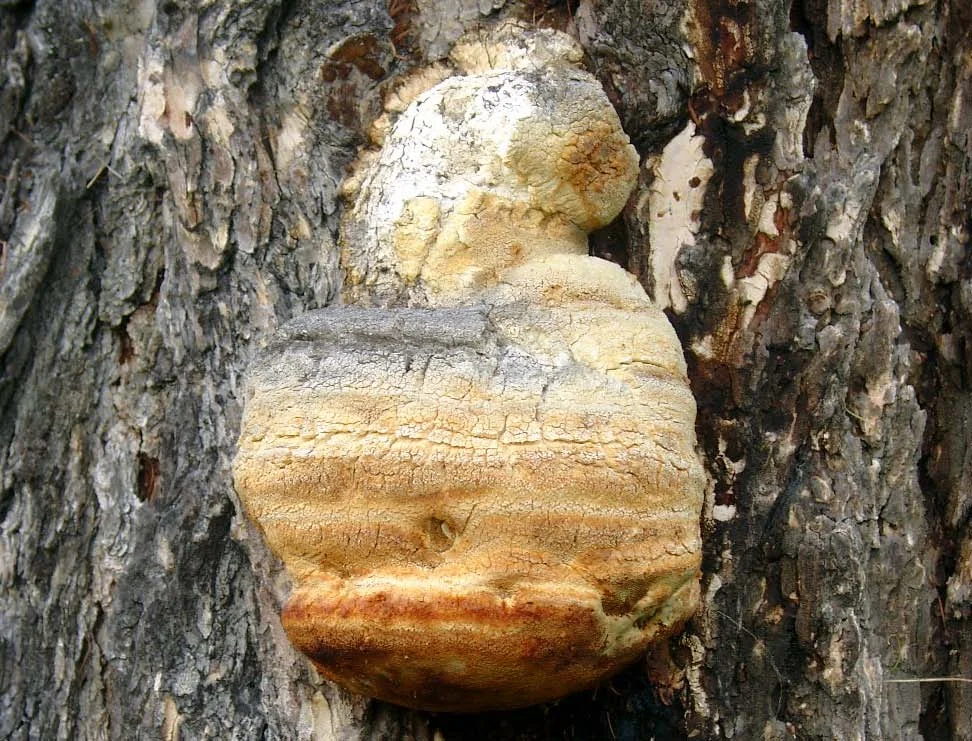
Laricifomes officinalis, commonly called agarikon or the quinine conk, produces some of the largest fruiting bodies in the fungal world. Individual conks can hang up to 20 m (65 ft) above ground, reach lengths of 65 cm (2 ft) and girths over 40 cm (1½ ft), and weigh as much as 9 kg (20 lb). Young specimens are soft and yellow‑white, turning chalky and developing reddish, brown, or gray tones as they age. The surface cracks in a cubical pattern, exposing thick white felt that also tastes bitter. Spores are white, ellipsoidal, and released from the underside during warm months. (Wikipedia)
Where It Lives and Why It Matters
Agarikon is a specialist of old‑growth conifer forests across Eurasia, Morocco, and North America. It prefers larch (Larix) but also colonises pine (Pinus) and cedar (Cedrus). The fungus causes brown heart rot, eventually killing the host tree; a single conk often signals a fully infected trunk that can become a micro‑habitat for snag‑nesting birds and insects. Because the fungus depends on mature, undisturbed wood, loss of old‑growth forests, invasive pests, and unregulated harvesting have driven its populations sharply downward. Conservation measures exist in Germany, Lithuania, Poland, and Slovenia, but most of its range lacks legal protection. (Wikipedia)
A Cultural Treasure: Masks, Textiles, and Medicine
Indigenous peoples of the Pacific Northwest—such as the Tlingit, Haida, and Tsimshian—revered agarikon as “bread of the ghosts.” Carved conks served as ritual masks and were placed on shaman graves, reflecting a spiritual significance that spanned generations. The same cultures processed the mycelium from rotting wood into a leather‑like textile, showcasing an early example of fungal material engineering.
In the ancient Mediterranean, the Greek physician Pedanius Dioscorides recorded agarikon’s use against “consumption” (tuberculosis) around 65 CE. Later, some Native American groups applied it to smallpox lesions. The bitter taste of powdered conks earned the nickname “quinine conk,” though modern analysis confirms it does not contain quinine and lacks antimalarial activity. (Wikipedia)
Modern Science: Antiviral Promise and Chemical Discoveries
Mycologist Paul Stamets has spearheaded laboratory investigations into agarikon’s bioactivity. Extracts have shown in‑vitro antiviral effects against several viruses, including poxviruses, herpes simplex 1 & 2, and both Influenza A and B strains. Additionally, research identified chlorinated coumarins with low minimum inhibitory concentrations against the Mycobacterium tuberculosis complex. These findings suggest agarikon harbours compounds worth deeper pharmacological study, though all results remain confined to cell‑culture models and have not been validated in clinical trials. (Wikipedia)
Challenges of Cultivation and Conservation Efforts
Unlike many cultivated mushrooms, agarikon is notoriously difficult to grow. Its natural lifecycle depends on long‑term decay of large conifer logs, a condition hard to replicate in a farm setting. Recent experiments have inoculated larch branches with mycelium, achieving limited success, and some researchers propose ex‑situ cultivation as a safeguard against extinction. However, most efforts focus on protecting the old‑growth habitats that support natural populations. Sustainable forestry practices, legal protections, and public awareness are essential to keep this giant fungus from disappearing. (Wikipedia)
Why Agarikon Matters for the Future of Fungal Innovation
Agarikon exemplifies how a single species can intersect ecology, culture, and cutting‑edge science. Its massive, long‑lived conks remind us of the hidden wealth in ancient forests, while its bioactive compounds spark curiosity about new medicines. As the Mushroom 2 Mars community explores sustainable fungal cultivation beyond Earth, understanding the challenges of growing complex wood‑decay species like agarikon can inform strategies for cultivating resilient, multifunctional fungi in closed‑loop habitats—perhaps one day even on the Red Planet.
Sources
This article is for general information only and is not medical advice. Do not use it to diagnose or treat any condition; talk to a doctor about health questions.
This article was prepared with AI assistance from the sources listed above and approved by the Mushroom 2 Mars team before publication.