Part of the guide: Mushrooms: A Complete Guide to Identification, Cooking, and Cultivation
Taxonomic Roots and Recent Reclassification
Boletus nobilis was first described by Charles Peck in 1910. For decades it was treated as a variant of the celebrated Boletus edulis, but modern DNA‑based phylogenetic work has placed it in its own clade, closely allied with Boletus separans. This shift underscores how molecular tools continue to refine our understanding of fungal diversity, even for species that have been known for more than a century.
Distinctive Morphology
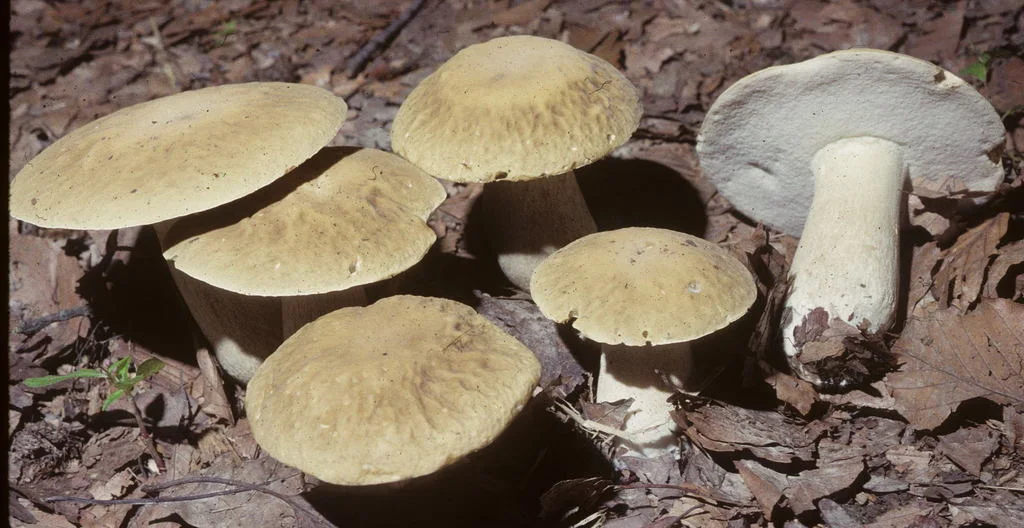
Although a bolete, B. nobilis does not reach the massive size of its cousin, the king bolete. The cap (pileus) spans 7–20 cm, starting convex and flattening with age. Its skin ranges from yellow‑brown to reddish‑brown, often lighter in the centre and fading to a pale ochraceous tone as the mushroom matures. The flesh remains thin even in larger specimens, a useful field clue.
The pores on the hymenium are a clean white, persisting without the greenish tint that sometimes appears on aging B. edulis. They stay level with the stipe rather than forming a depression. The stipe itself is elongated, sometimes bulbous at the base, and generally white with a possible lilac hue. Fine, shallow reticulation appears below the pore surface, giving the stem a subtle net‑like texture. A spore print yields dull ochre‑brown to rusty‑brown tones.
Habitat and Seasonal Patterns
Boletus nobilis favors the mixed hardwood forests of the Appalachian region, extending from Pennsylvania through Ohio to the Atlantic coast. It forms ectomycorrhizal relationships with oak (Quercus) and beech (Fagus) trees, exchanging nutrients for photosynthates. Fruit bodies appear from summer into fall, often after periods of rain that raise soil moisture.
Identifying the Noble Bolete in the Field
Accurate identification is essential, especially because many boletes are edible while others can cause gastrointestinal upset. Key field markers for B. nobilis include: - A cap with a dry, yellow‑brown to reddish‑brown surface that lightens centrally. - White pores that remain unchanged with age. - An elongated, sometimes bulbous stipe that is white or faintly lilac, with shallow reticulation. - Thin flesh throughout the mushroom. Because it closely resembles B. edulis, checking the pore color and stem reticulation can prevent misidentification. Always consult a local expert or reliable field guide before collecting any wild mushroom.
Culinary Potential and Safe Preparation
While edible, B. nobilis is generally considered less flavorful than the prized king bolete. Nevertheless, it can be used in a variety of dishes. The thin flesh holds up well to sautéing, braising, or inclusion in soups. Because the texture remains delicate, avoid overcooking, which can make the caps soggy.
A simple preparation: 1. Clean the caps with a damp cloth; avoid soaking to prevent waterlogging. 2. Slice the mushrooms uniformly (about ½ cm thick). 3. Heat a skillet with a tablespoon of olive oil over medium heat. 4. Add the slices, season with salt, pepper, and a splash of fresh lemon juice. 5. Cook for 4–5 minutes, turning once, until the edges turn golden. 6. Finish with chopped parsley and serve over toasted bread or mixed into a risotto.
Freezing is also an option: blanch the sliced mushrooms for 2 minutes, shock in ice water, drain, and pack in airtight bags. Frozen specimens retain good texture for later sautéing.
Conservation and the Future of Boletus nobilis
Boletus nobilis is not currently listed as threatened, but its reliance on mature oak and beech stands makes it vulnerable to habitat loss. Sustainable foraging practices—such as taking only a few specimens per patch and leaving the mycelial network intact—help preserve local populations. In the broader context of fungal conservation, protecting forest continuity is vital for maintaining the symbiotic relationships that support both trees and their fungal partners.
From Earth to Mars: A Fungal Frontier
The noble bolete’s ability to thrive in symbiosis with trees offers inspiration for future space agriculture. Projects like Mushroom 2 Mars explore how fungi could support life‑support systems on other planets, turning waste into nutrients and perhaps even providing a future source of edible fungi for explorers.
Sources
This guide is not a foraging or identification manual. Many edible mushrooms have toxic look-alikes. Never eat a wild mushroom unless an expert has identified it in person.
This article was prepared with AI assistance from the sources listed above and approved by the Mushroom 2 Mars team before publication.