What Is Enoki?
Enoki mushrooms, scientifically named Flammulina filiformis, belong to the family Physalacriaceae. Although once thought to be the same species as the European Flammulina velutipes, DNA analysis has confirmed they are distinct. The Japanese name “enoki‑take” translates to “hackberry mushroom,” reflecting its natural habit of growing at the base of hackberry trees. In Mandarin the mushroom is called jīnzhēngū (gold needle mushroom), and in Korean it is known as paengi beoseot.
Appearance and Habitat
Wild enoki produce small, convex caps that expand to about 4.5 cm in diameter, with a smooth, slightly sticky surface that ranges from ochraceous yellow to brown. The gills are cream‑to‑yellowish white, and the stems can reach up to 8.5 mm long. A key visual difference between wild and farmed fruit bodies is lighting: cultivated enoki are grown in darkness, yielding long, pale stems and tiny, almost invisible caps. In nature the fungus colonizes dead wood of broad‑leaf trees such as birch, paper mulberry, and willow across China, Korea, and Japan.
Growing Enoki at Home or in Factories
Large‑scale production relies on simple lignocellulosic substrates like sawdust, wheat straw, or paddy straw. The process begins with an incubation phase at warm, moist temperatures (18‑25 °C). Once the mycelium has colonized the substrate, the environment is cooled to 7‑10 °C to trigger pinning, and then maintained at 10‑16 °C for fruiting. Humidity must stay high—95‑100 % during pinning and 85‑95 % during fruiting—to keep the delicate stems from drying out.
For hobbyists, a small indoor kit can replicate these conditions: keep the substrate in a sealed container, provide a brief refrigeration period to initiate pinning, and maintain a misting schedule to sustain humidity. Harvest when the stems are 5‑10 cm long and the caps are still tightly closed; a clean cut with scissors preserves the next flush of growth.
Nutritional Highlights
Enoki mushrooms are mostly water (about 88 %). A 100‑gram serving supplies roughly 37 kcal, 3 % protein, and negligible fat. They are especially rich in B‑vitamins: they provide over 40 % of the daily value for niacin and about 30 % for pantothenic acid, while also contributing modest amounts of thiamine, riboflavin, folate, and potassium. Because they are low in calories and high in fiber, enoki can be a useful addition to a balanced diet.
Culinary Applications
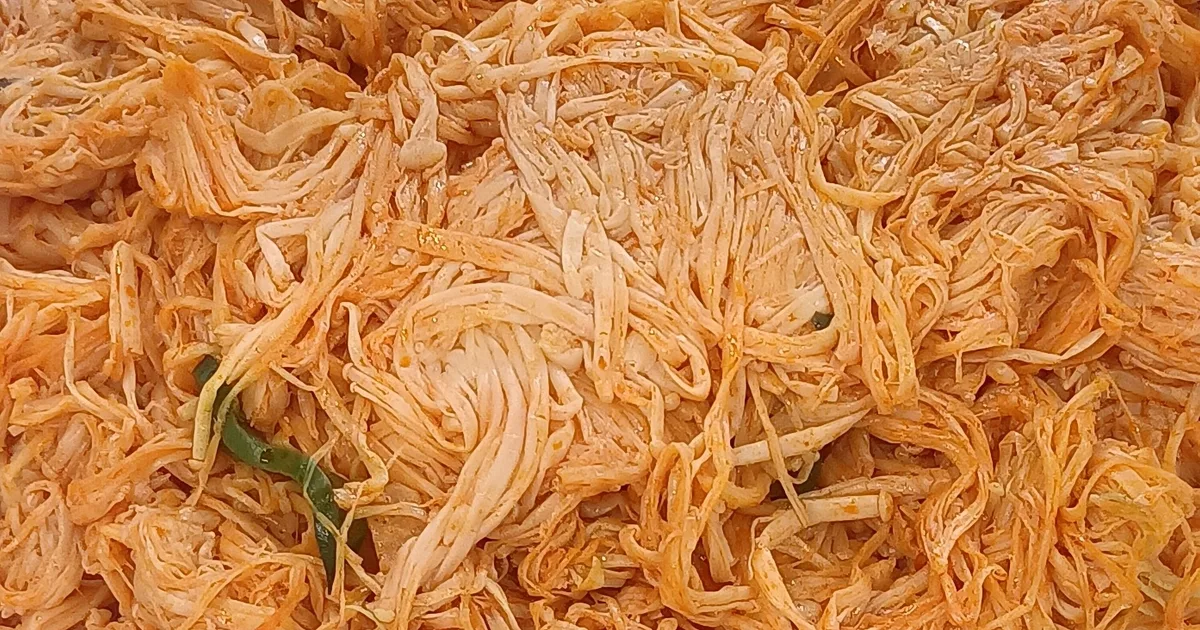
The crisp, delicate texture of enoki makes them a favorite for soups, hot pots, and salads throughout East Asian cuisine. They are sold fresh or canned and keep in the refrigerator for about a week. A simple preparation is a miso‑based noodle soup: rinse the mushrooms, add them to simmering broth for just a couple of minutes, and finish with sliced scallions and a splash of soy sauce.
Quick Enoki Soup Recipe
- 200 g fresh enoki, trimmed
- 4 cups vegetable or dashi broth
- 2 tbsp miso paste
- 1 tsp sesame oil
- 2 tsp soy sauce
- Chopped scallions for garnish
- Bring the broth to a gentle boil, then lower to a simmer.
- Stir in miso until dissolved; add sesame oil and soy sauce.
- Add the enoki and cook for 2‑3 minutes until the stems are tender but still crisp.
- Serve hot, garnished with scallions.
Because enoki are cultivated in the dark, they have a mild flavor that readily absorbs surrounding seasonings. Researchers are also exploring enoki stem waste as a functional ingredient: powdered stems can boost dietary fiber in meat products, improve tenderness, and extend shelf life without altering taste.
From Earth to Mars
Understanding how enoki thrive in low‑light, controlled environments helps inform the design of sustainable mushroom farms for future Mars habitats.
Sources
This guide is not a foraging or identification manual. Many edible mushrooms have toxic look-alikes. Never eat a wild mushroom unless an expert has identified it in person.
This article was prepared with AI assistance from the sources listed above and approved by the Mushroom 2 Mars team before publication.