A Distant Glow in the Southern Sky
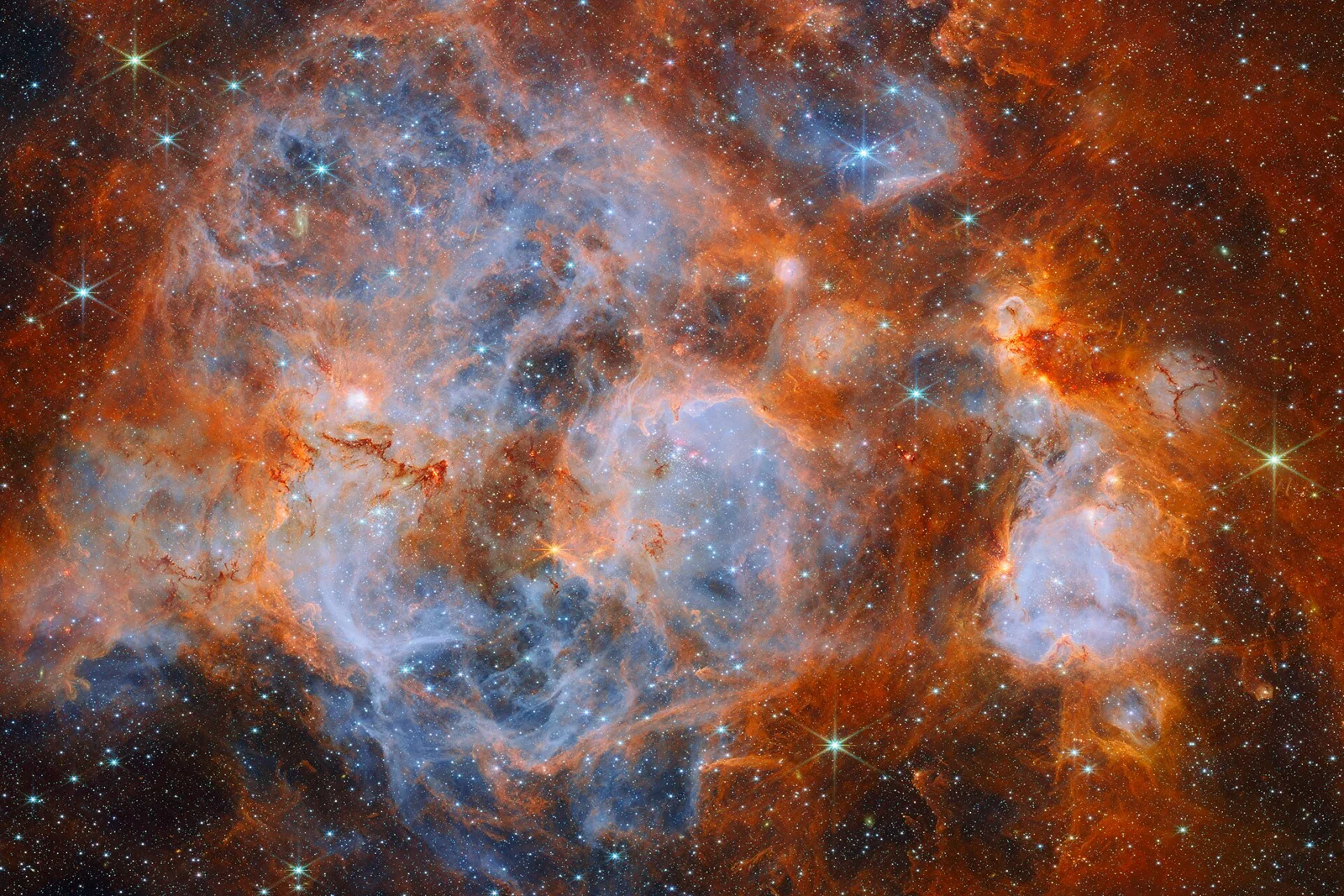
The James Webb Space Telescope recently delivered a striking infrared portrait of a star‑forming complex located in the Large Magellanic Cloud, a satellite galaxy that orbits our Milky Way. The region, catalogued as N159, sits roughly 161,000 light‑years from Earth and spans about 230 light‑years across. In the image, bright blue patches of ionized hydrogen sit at the heart of a swirling, orange‑tinged cloud, giving the whole structure the appearance of a glowing cauldron.
What the Colors Mean
Infrared observations highlight three main components. The central blue glow comes from hydrogen atoms stripped of their electrons – known as H II regions – which shine when they recombine after being bathed in intense ultraviolet radiation from newly formed massive stars. Encircling this core are reddish filaments of molecular hydrogen, denser pockets where gas is still collapsing under gravity. Finally, the surrounding orange haze is produced by polycyclic aromatic hydrocarbons (PAHs), complex organic molecules that fluoresce when excited by stellar light. The U.S. Department of Energy notes that PAHs may contain up to a third of the universe’s carbon, making them a key ingredient in the chemistry of galaxies.
A Nursery Fresh Out of the Cosmic Oven
Astronomers estimate N159 to be under three million years old, placing it among the youngest stellar nurseries observed in the Large Magellanic Cloud. Its relatively low metallicity – meaning fewer elements heavier than helium – mirrors the composition of the early universe, when the first generations of stars ignited. By comparing such low‑metal environments with richer regions in our own galaxy, researchers can test models of how stars formed when the cosmos was still in its infancy.
Peering Into Stellar Birth Stages
The high‑resolution view lets scientists track several phases of star formation. Pre‑main‑sequence stars, still gathering mass from the surrounding cloud, appear as faint infrared points embedded within the dense filaments. More mature young stars have already cleared out cavities with powerful stellar winds, shaping the chaotic architecture of the nebula. Observing these objects side by side provides a natural laboratory for studying how protostars evolve into fully fledged suns.
Why JWST Matters for This Discovery
JWST’s 6.5‑meter primary mirror, often described as a golden eye, collects far more infrared light than its predecessors. This capability is crucial for cutting through the dust that obscures star‑forming regions in visible wavelengths. By targeting N159, the telescope not only captures a beautiful image but also gathers spectra that reveal the chemical fingerprints of gases, dust grains, and PAHs. Such data help refine our understanding of the physical conditions that prevailed shortly after the Big Bang.
From Cosmic Clouds to Future Colonies
While the image is a reminder of the vastness of space, it also resonates with the goals of projects like Mushroom 2 Mars, which aim to grow fungi in extraterrestrial habitats. The same organic molecules that light up N159’s orange veil—PAHs—are building blocks that could support future bioregenerative life‑support systems on other worlds. As we learn how stars and complex organics arise naturally, we gain clues for cultivating life beyond Earth.
The next time you gaze at the night sky, imagine the hidden cauldrons of creation swirling in distant galaxies, seeding the universe with the chemistry that eventually made mushroom farms on Mars possible.
This article was prepared with AI assistance from the sources listed above and approved by the Mushroom 2 Mars team before publication.