Part of the guide: Mushrooms: A Complete Guide to Identification, Cooking, and Cultivation
Why Coffee‑Cherry Husk?
Coffee‑cherry husk, the outer layer left after extracting beans, is an abundant agricultural by‑product. It contains cellulose, hemicellulose, and residual sugars that provide a solid nutritional base for fungi. Studies on lignocellulosic waste show that supplementing standard straw or sawdust with coffee‑cherry husk can boost mycelial colonization speed and fruiting body weight (see research from the University of Florida on spent coffee grounds). Using husk reduces waste and lowers the carbon footprint of mushroom production, aligning with circular‑economy principles.
Preparing the Husk
- Collect and dry – Gather fresh husk from a coffee‑processing facility or local roaster. Spread it thinly on a clean surface and air‑dry for 24‑48 hours, or use a low‑heat oven (45‑55 °C) until the moisture content falls below 12 %.
- Grind to uniform size – A kitchen grinder or food processor can break the husk into 1‑2 cm pieces. Uniform particles improve water absorption and packing density.
- Pre‑soak – Place the ground husk in a large container and add warm water (45‑50 °C) at a 1.5:1 water‑to‑dry ratio. Stir and let soak for 30 minutes; this hydrates the fibers and leaches excess tannins that could inhibit mycelial growth.
Sterilizing the Substrate
Sterilization eliminates competing microbes that would otherwise colonize the husk.
Pressure‑cooking method (recommended for home growers)
- Load the soaked husk into autoclavable bags or heat‑proof jars, leaving a 2‑cm headspace.
- Seal with a filter patch or breathable tape to allow gas exchange after sterilization.
- Process at 121 °C (15 psi) for 60 minutes. For larger volumes, increase the time to 90 minutes to ensure heat penetrates the core.
- Cool the bags rapidly by placing them in a clean, cool room (below 25 °C). Once cooled, inoculate within 2 hours to minimize contamination risk.
Alternative: Pasteurization (for low‑tech setups)
If a pressure cooker is unavailable, pasteurize the husk in a large pot at 70‑75 °C for 90 minutes, maintaining temperature with a kitchen thermometer. This method reduces, but does not eliminate, competing organisms, so work in a clean environment and consider adding a small amount of gypsum (5 % of dry weight) to buffer pH.
Inoculation and Incubation
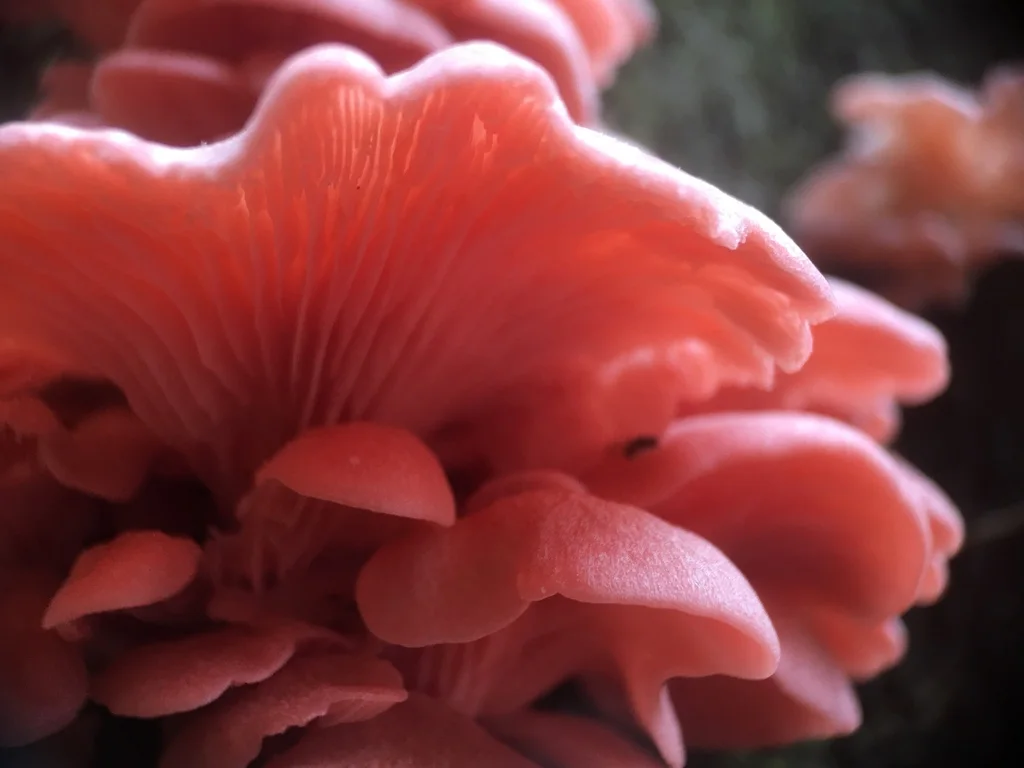
- Mix the sterilized husk with oyster mushroom spawn (Pleurotus ostreatus) at a 5 % spawn‑to‑substrate ratio by weight. For a 5‑kg bag, use about 250 g of spawn.
- Shake the bag gently to distribute the spawn evenly. Seal the bag again with breathable tape.
- Incubate in a dark, warm space (22‑25 °C) for 10‑14 days. The mycelium will colonize the husk, turning it white and compact.
- Initiate fruiting by moving the bag to a fruiting chamber with 85‑90 % relative humidity, fresh air exchange, and indirect light (500–800 lux). Cut slits in the bag to allow mushrooms to emerge.
Harvesting and Yield Expectations
Oyster mushrooms typically reach harvest size within 5‑7 days after pinning. With coffee‑cherry husk, growers report yields of 0.8‑1.2 kg of fresh mushrooms per kilogram of dry substrate, comparable to or slightly higher than traditional straw mixes. Harvest by twisting or cutting at the base, and reuse the spent substrate as a soil amendment or compost.
Sustainability Benefits and Future Outlook
Utilizing coffee‑cherry husk transforms a waste stream into a valuable resource, reducing landfill load and providing growers with a locally sourced substrate. For home cultivators, the process is low‑cost and aligns with eco‑friendly practices. In larger‑scale operations, the same principle can be adapted to vertical farms or even space habitats, where every gram of waste must be repurposed. As we look toward sustainable food production on Earth and beyond, turning coffee by‑products into mushroom feed illustrates how circular agriculture can support both planetary health and future Martian farms.
Imagine a future where the same husk that once surrounded a coffee bean helps feed astronauts growing oyster mushrooms on Mars.
Sources
- Utilization of Coffee By‑Products for Mushroom Cultivation
- Spent Coffee Grounds as a Substrate for Pleurotus ostreatus
This article was prepared with AI assistance from the sources listed above and approved by the Mushroom 2 Mars team before publication.